
Lesson 6 - Milling Technology
This lesson deals with the principles of design and operation of the various mill types. It also explains the criteria used for their selection.
Four-Roller Dry Mill
The four-roller mill is a step-up in size and complexity and is used in medium-sized breweries with mash tuns, and perhaps some using lauter tuns.
In a four-roller mill, there are two stages of comminution, with or without an intermediate step diverting husk and flour away from the second rollers. The first set of rollers has a typical mill gap of 1.3-1.9 mm, while the gap between the second set is between 0.25-1 mm. Four-roller mill mills can produce grist at a rate of 2-6 kg/h per mm of roller length. The first set of rollers tends to be 300 mm in diameter and operates at between 210 and 230 rpm. The second set has the same diameter, but operates at 280 rpm and typically has a greater degree of fluting.
Four-roller mills are designed to mill well- and over-modified base malts along with speciality malts, and are most common in ale breweries. They are able to process pre-gelatinised adjuncts but will not mill raw barley effectively.
Grain is fed into the mill by gravity, with either a feed roller or a feed plate distributing the corns evenly over the first set of crushing rollers. In the simplest designs, the grain is milled by the first and second rollers without processing in between. This design gives a more complete crush than a two-roller mill, but gives little improvement in grist particle size control. This type of mill is shown in the figure below.
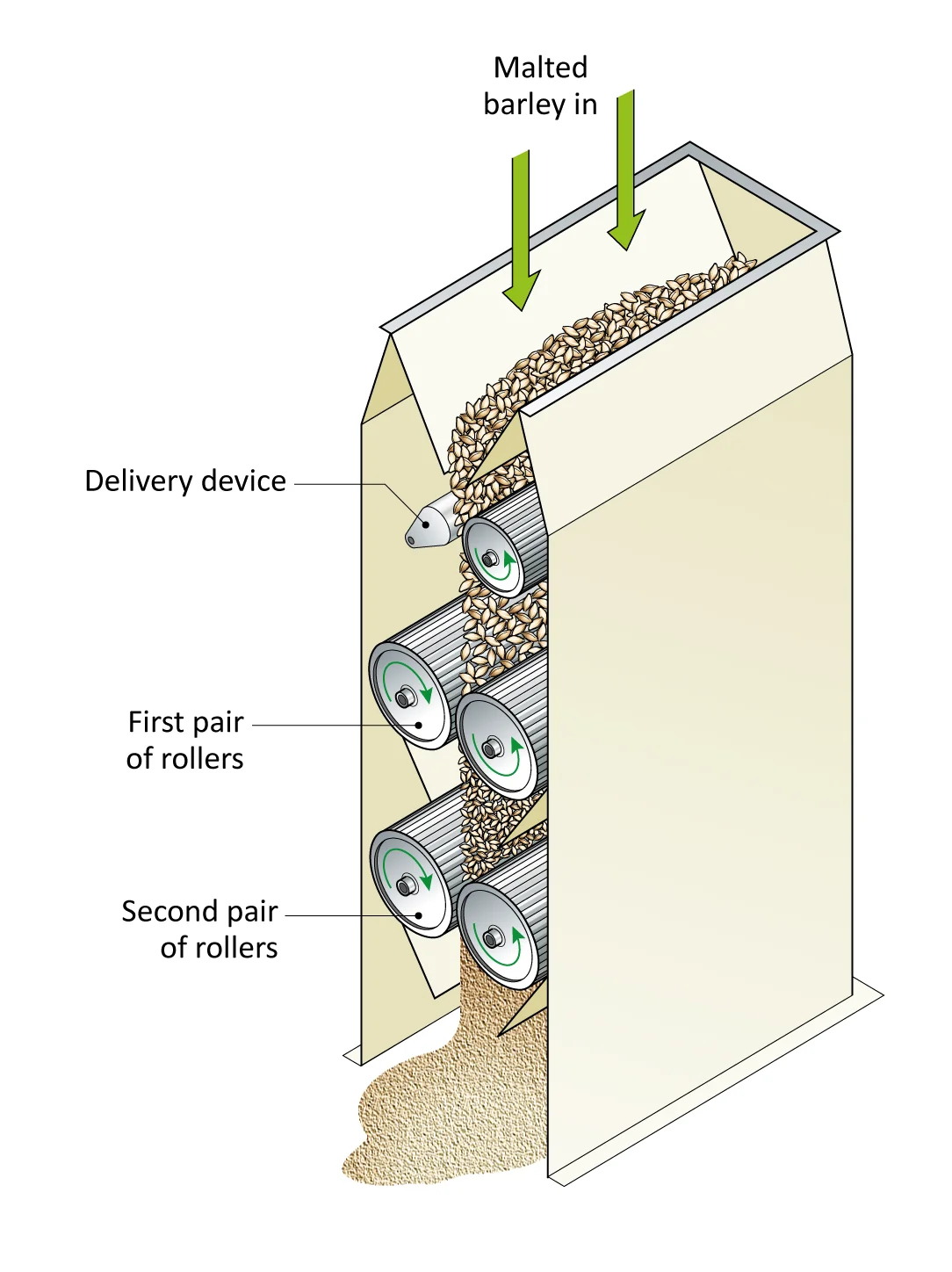
Figure: The four-roller dry mill without screening
More sophisticated four-roller mills have screens between the pairs of rollers to separate out the flour and husk or fine grits produced by the first set, that do not require further processing in the second set. These can be rotary screens with beaters (as shown in the figure below) or a series of reciprocating flat screens.
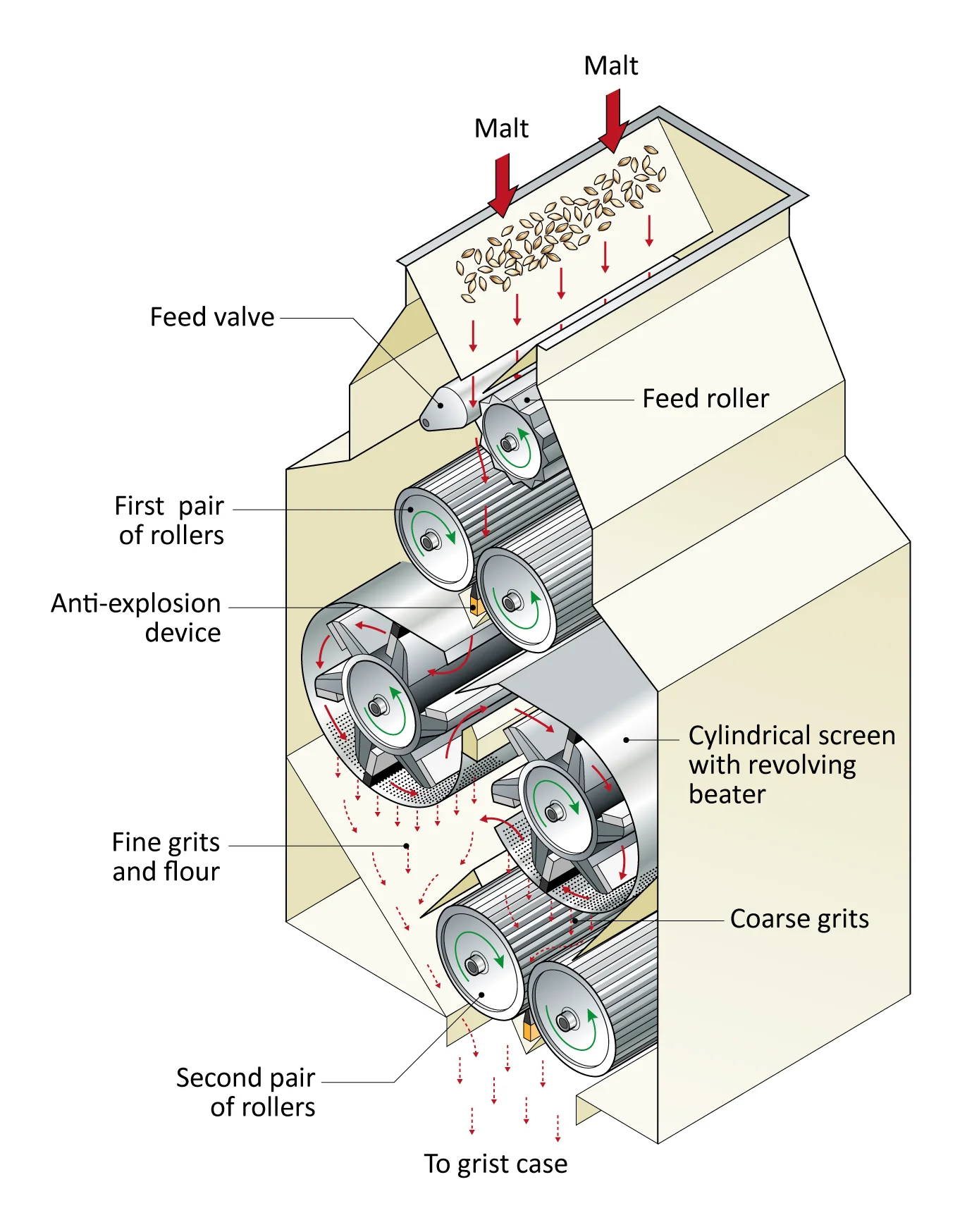
Figure: Four-roller mill with rotary screens
Machines with reciprocating screens can achieve a greater throughput than those with rotary screens. Separating out the husk means there are a greater number of larger husk particles available to make up the filter bed during wort separation.
All types of four-roller mill should have a plate below each of the crushing rollers to keep the space below the rollers full of grist. This helps smother any sparks that might occur if the rollers hit flints or metal items in the grain.
Five-roller mill
The five-roller mill was the forerunner of the six-roller mill and increases the number of milling stages to which the grain is subjected. This gives a level of particle size distribution control close to that of a six-roller mill. While not as rare as the three-roller mill, they are far less common although lower cost, than the six-roller mill. The figure below shows a five-roller mill.
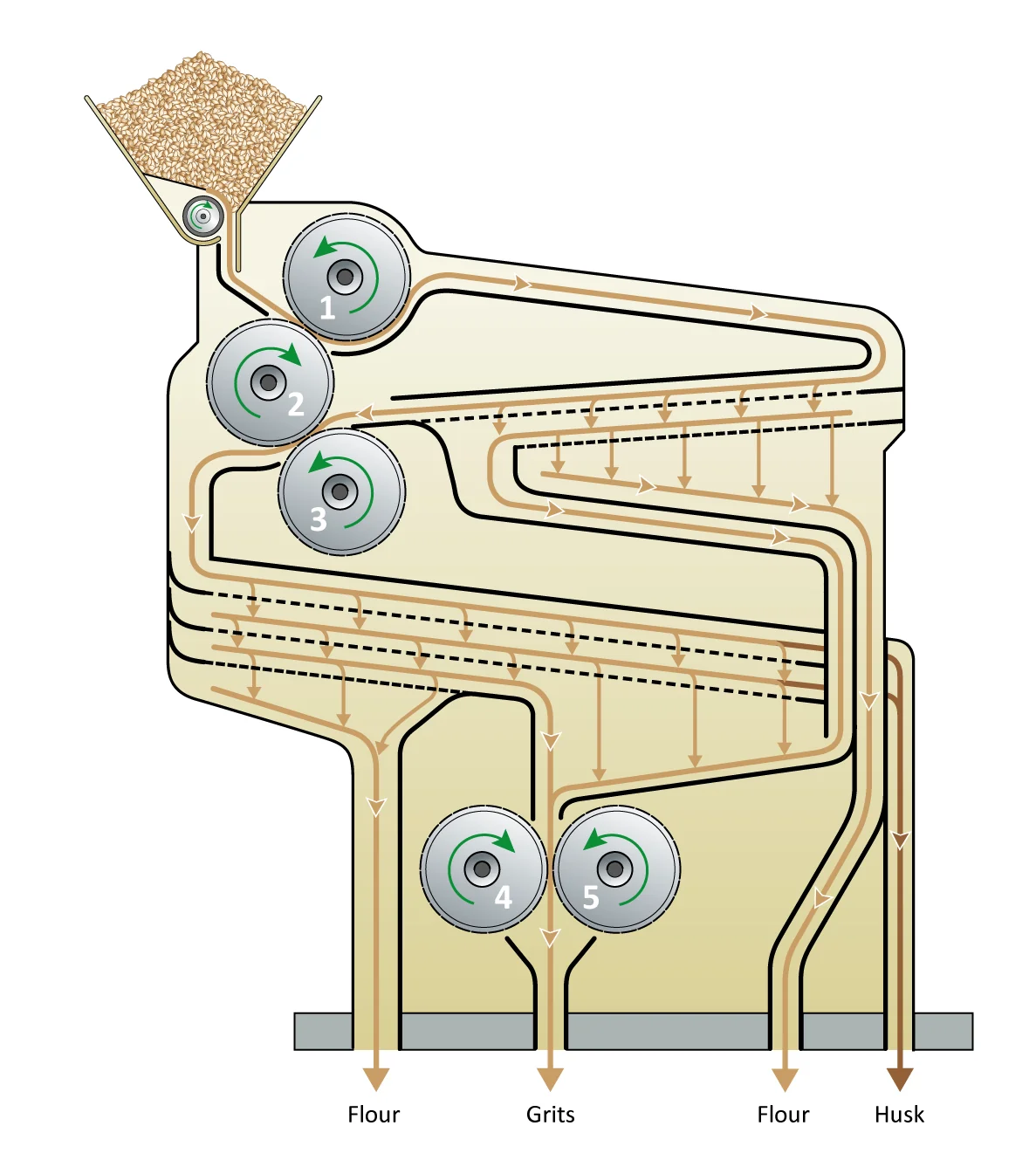
Figure: Five-roller mill
The five-roller mill uses the first pair of rollers (one and two) to crush. Screens then separate the flour, grits, and husk fractions. The screened grist is then crushed between the second pair of crushing rollers (two and three). This means that roller two completes twice the amount of work, thus wearing more rapidly. The grist is screened again before it is milled by the third pair of crushing rollers (four and five).