
Lesson 6 - Milling Technology
This lesson deals with the principles of design and operation of the various mill types. It also explains the criteria used for their selection.
Steep Conditioned Mill
Steep conditioned mills have a rather confusing name. To steep is to ‘soak thoroughly’, which suggests that our malt would stay submerged in water for an extended period. However, the ‘steeping’ in fact only takes 30-60 seconds.
Steep conditioned mills differ from full steep wet mills, in that the grain is not wetted in the hopper above the mill but in a chamber between the hopper and the mill. The temperature of the water used is also higher. Typical temperatures are between 55 and 70°C. The higher temperature of the water used means that moisture uptake is faster. Temperatures of up to 80°C have been suggested to denature the malt lipoxygenase enzymes LOX that are implicated in the production of stale beer flavour. LOX is covered in detail in the Mashing unit. Higher temperatures also affect the enzymes that we need in the mash, so the temperature chosen should take account of the enzyme level in the malt and what enzymes we need to operate in the mash. Conditioning increases husk moisture level to 18-22%, but the endosperm remains largely unchanged. The figure below shows a steep conditioned mill.
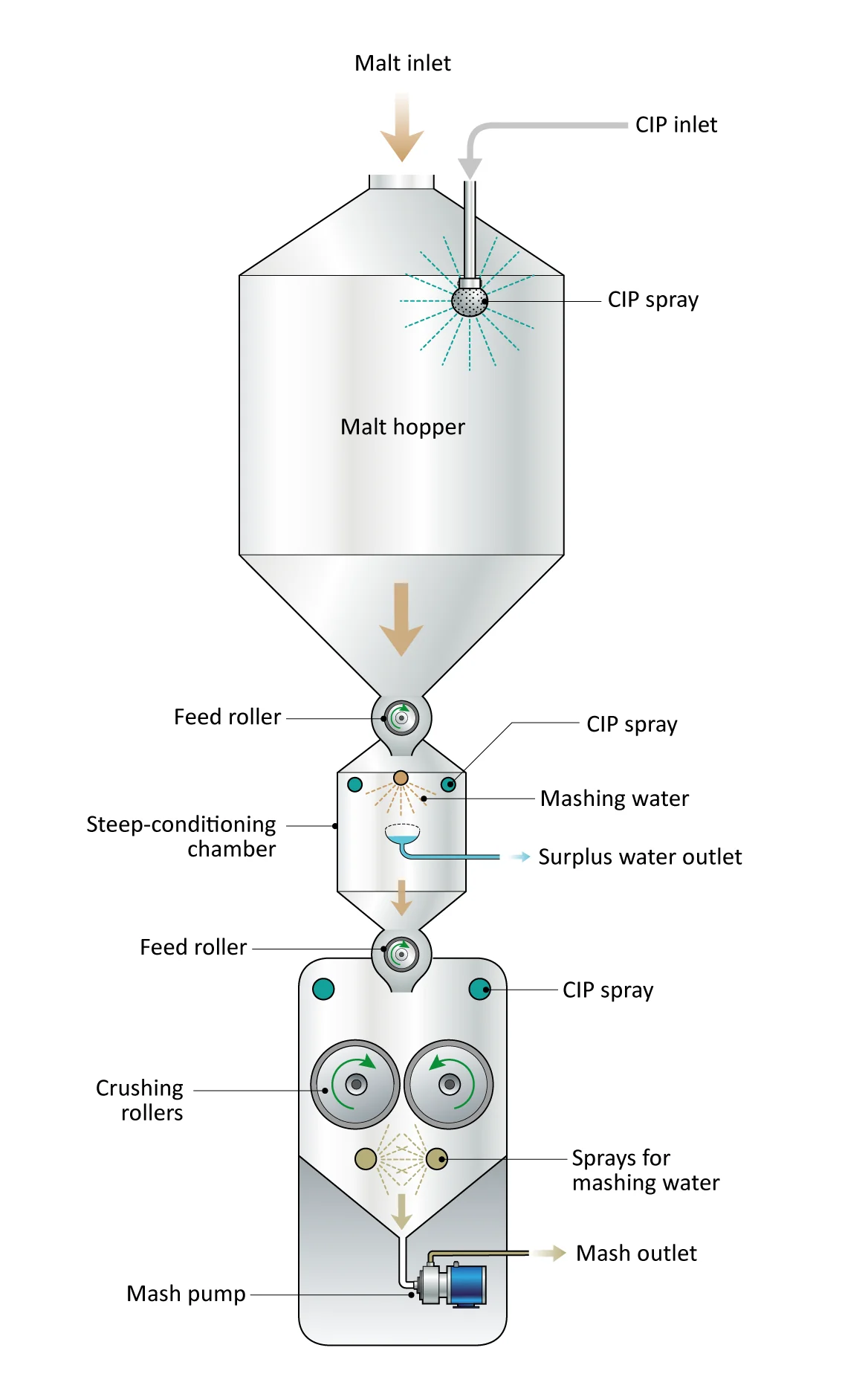
Figure: Steep conditioned mill
Malt is fed from the storage hopper into the steeping chamber (sometimes called the chute or cylinder) where water is sprayed onto its surface. A feed roller regulates the flow of malt in order to ensure that the chamber is not overfilled and that water can access the grain easily. The speed of this feed roller can be adjusted to increase or reduce the residence time of the malt, and hence the steeping time. Excess water is drained from the chamber as necessary. This is usually recovered and used as mashing water. The conditioning time is determined by the speed at which the grain flows through the mill. A control system and gears ensure that the rate of malt entering the system matches that of the mash leaving the system. A feed roller above the crushing rollers meters the grain onto the crushing rollers, distributing it evenly across them. After crushing, the grist is hydrated with sprays of mashing water to produce the mash. The mash is then pumped to the mash conversion vessel. After milling, the mill is flushed with water to remove as much of the malt/grist residue as possible.
The crushing rollers are typically between 290 and 420 mm in diameter. The mill gap and roller speed can be adjusted to take account of the malt’s degree of modification, with the mill running slower to both hydrate and crush under-modified grain to a greater extent. Typical gaps between the crushing rollers are between 0.25 and 0.4 mm, while speeds range from 25 to 430 rpm. The risk of oxidation is greater than in a full steep wet mill, but this can be mitigated by using deoxygenated water and flushing the system with CO2 or nitrogen. Lactic acid can be added in the mill to reduce pH, and hence the activity of malt LOX.
The crushing rollers and the steeping chamber are constructed from chrome-nickel steel to resist corrosion.
Like the full steep wet mill, the system needs to be regularly cleaned in place with alkaline and acid detergents to prevent the build-up of soil and biofilm.
Advantages of the steep conditioned mill:
-
Less husk damage compared to dry mills
-
Less damage to acrospire to lower LOX activity than dry mills
-
Reduced roller gaps for improved comminution, compared to full steep wet mills
-
Easier to control than a full steep wet mill
-
Improved extract recovery compared to full steep wet mills
-
Improved wort separation compared to dry mills
-
Possible to add lactic acid during operation
-
Reduced risk of explosion verses dry mills
Disadvantages of the steep conditioned mill:
-
Oxygen control is harder than in full steep wet mills
-
Corrosion can be a problem
-
More difficult to keep clean than a dry mill
-
Higher water use and effluent production than a dry mill
-
Plansifter for grist analysis cannot be used
We have now covered the types of wet mill that use rollers. Next, we move on to a wet mill that uses a very different method of comminution.