
Lesson 8 - Brewing with Hops
This lesson deals with brewing with hops. Topics covered include: the effect of when hops are added, the equipment required, selecting hops and hop addition calculations.
Hop Dosing Equipment – Dry Hopping
Over the last 20 years dry hopping has become very common. As a result a wide range of options for dry hopping are available.
Dry hopping is the addition of hops, or hop products, after wort cooling.
Some of the main factors affecting the effectiveness of dry hopping include:
- Particle size of hop – smaller particles that are well dispersed give up their aroma compounds easier than larger particles that may not be fully wetted. Extraction from the milled hop particles found in powder and pellets is faster than from whole cone hops. Small differences in hop particle size have less of an effect.
- Condition of lupulin glands – this ties in to the last point to a degree, because chopping up hop cones into tiny particles generally disrupts the lupulin gland. It makes sense that essential oils locked in a plant gland will dissolve in beer less readily than those coating plant material.
- Temperature of the beer – as temperatures increase, the energy in the beer increases. This energy drives dissolution and diffusion so the higher the temperature, the faster the extraction. Dry hopping at 12°C should provide faster extraction of flavour compounds than at 0°C. In fact, at 0°C hop plant material does not swell which significantly reduces extraction rates. When we say flavour compounds, this includes those that you might not want!
- Concentration gradient between the compound in the beer around the particle and the surrounding beer – if the beer already has a high concentration of the compound in question or is generally saturated with similar compounds, the rate at which the compound is extracted will be low. If the beer is free of the compound, extraction is fast and more can be extracted. It is harder to extract hop flavour compounds in beers with a high present gravity/extract and highly hopped beers than it is in low present gravity/extract beers with low hopping rates. Agitating the beer so that the hop particles and beer are moving around, gives your particles the best chance of being in contact with beer that has a lower concentration of the compound you are trying to extract.
- Contact time – there is an optimum contact time for extraction of dry hop flavour. Different oils are extracted and can decline in concentration at different rates, so the flavour provided changes over the period of extraction.
- Alcohol concentration – as a general rule, the greater the alcohol concentration, the greater the extraction rate. That said, the increase is in the compounds that dissolve well in alcohol so what is extracted may be different to what is found in lower alcohol beers. Many of the compounds thought to be beneficial in dry hopped beers are extracted more easily at increasing alcohol levels.
- Dose rates – up to a point, it makes sense that more hops = more hop flavour. However, with some flavour compounds, above specific dose rates, their concentration declines. And it has been shown that the extraction efficiency of most aroma compounds declines with hop addition rates.
- Process losses – when dry hopping we are not only concerned with dissolving flavour compounds but also preventing them being lost. Many essential oil components are sparingly soluble so take every opportunity to leave the beer with CO2 or by sticking to hop plant material, yeast cells, filters and process equipment.
- Yeast – as well as removing flavour compounds by sticking to them, yeast also biotransforms them. This is sometimes beneficial and sometimes undesirable, usually depending on the type of hop aroma you want. Strains that carry the enzymes that catalyse biotransformation reactions are available.
- Enzyme products - bacterial β-glucosidase and β-lyase can be added to release aroma compounds from glycosylated and cysteinylated precursors.
However we dry hop, we must ensure that the vessels and lines are flushed with CO2 beforehand. This reduces the level of oxygen in the hops and equipment and hence reduces beer oxidation.
Many different dry hopping techniques and technologies are available. We don’t have space to cover them in depth. An internet search or the IBD short course on dry hopping can provide more information.
Methods are usually divided into static and dynamic methods. Dynamic methods use agitation or recirculation to help extract flavour compounds. Static methods rely on contact time.
Dry hopping in tank
This involves adding the hops to the fermentation or maturation (process) vessel before or after filling. Whole hops are added to a mesh sack before addition for easier removal. However, this provides a comparatively poor extraction of flavour. Pellets are usually added loose and disperse throughout the beer providing better extraction. Hops can be added manually both dry and in a slurry with water or beer. For automated addition, devices are available that:
- Use CO2 to blow pellets from a sealed vessel into the process vessel
- Dose pellets from a hopper into beer flowing through a recirculation loop from the vessel
- Slurry the hops in a vessel before pumping the slurry to the process vessel
In-tank dry hopping is a static method unless we agitate the vessel. Agitation can be done using pumped recirculation of the vessel, a mechanical agitator or an in-tank jet mixer. Spent hops sediment out or are removed using a centrifugal separator.
The figures, videos and links below show the various options and provide more information.
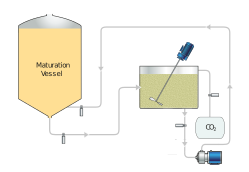
Figure:
Figure: Slurrying the hops in a vessel before pumping the slurry to a process vessel
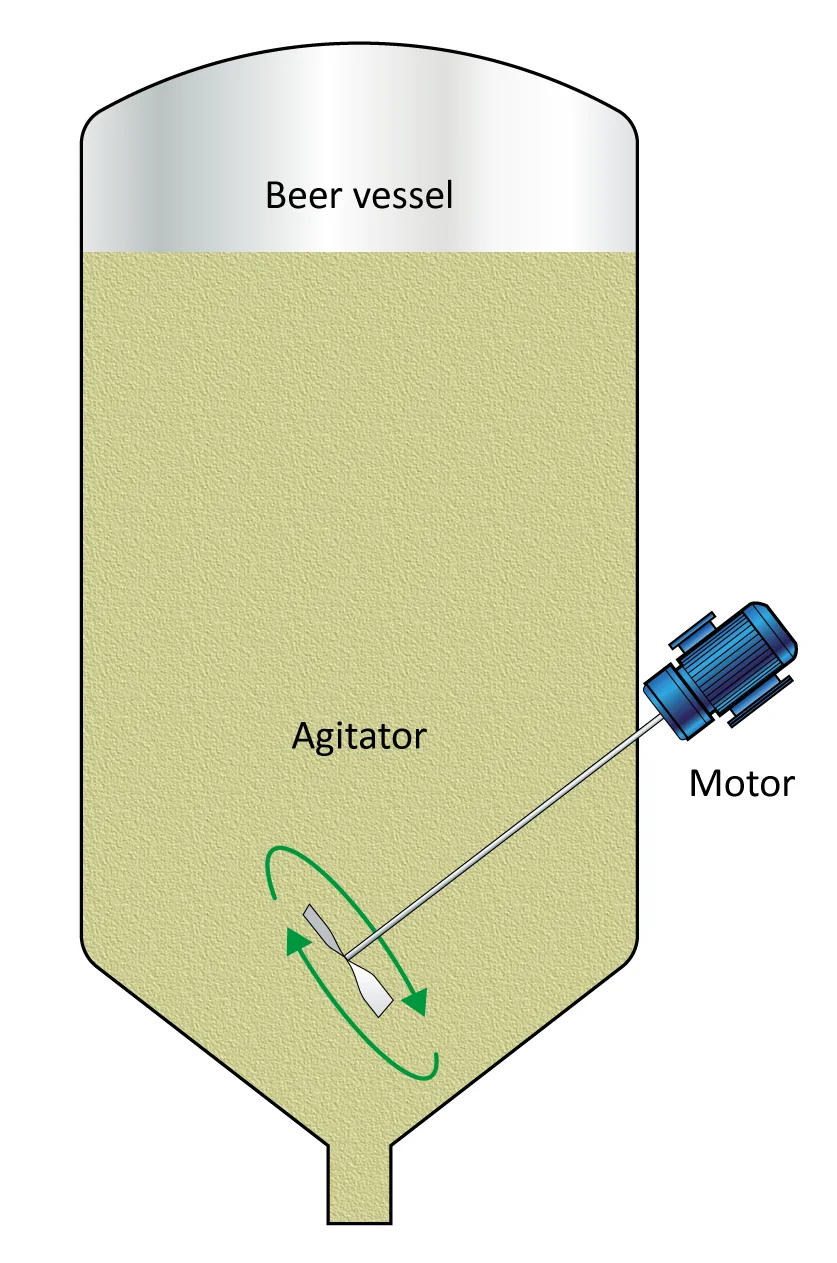
Figure: Agitator dispersing hops in process vessel
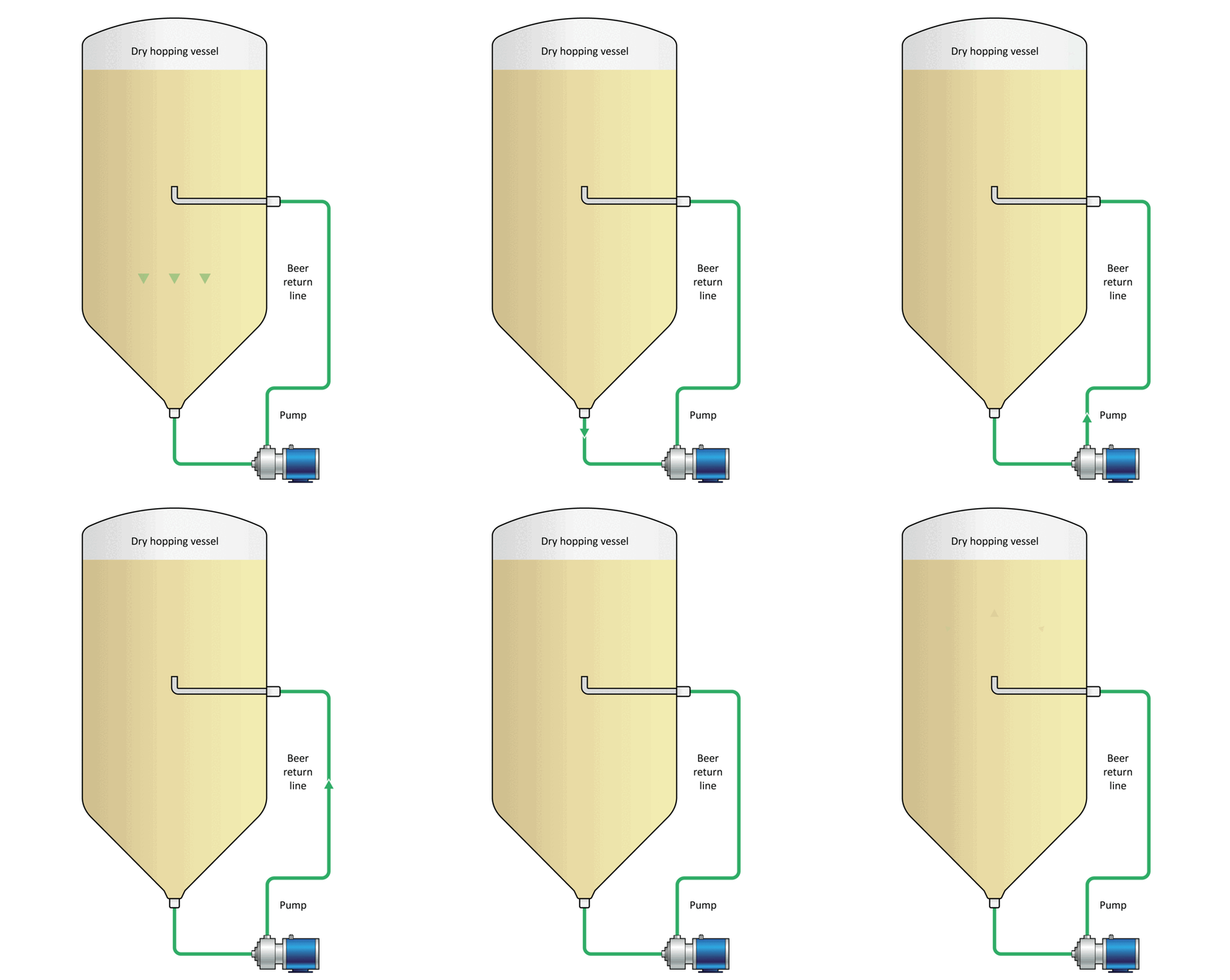
Figure: Pumped recirculation of dry hops in process vessel
Note, these links and videos are for illustrative purposes only and is not a recommendation or endorsement of the supplier’s product:
https://www.rolec-gmbh.com/dryhopnik/
https://www.ampcopumps.com/dry-hop-systems/
http://www.sprinkman.com/products/brewing-systems/dry-hopping#prettyPhoto
Dry hop flavour extraction in a separate vessel
Hops are added to an extraction vessel before beer is pumped from the process vessel, through the hop extraction vessel and back into the process vessel. The hops are held in place by a screen so most of the solid hop material remains in the extraction vessel. This method is always dynamic and usually provides faster extraction than most in tank options. The figure below shows the method and the links provide more details.
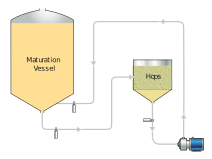
Figure: Continuous extraction of hops in a tank
Commercial examples of this method include (note, this is for illustrative purposes only and is not a recommendation or endorsement of the particular supplier’s product):
https://braukon.de/en/produkt/braukon-hopgun-en/
https://www.banke.de/en/hopgun
https://www.paulmueller.com/commercial-brewing-equipment/beer-and-beverage-infusion-system
https://www.bespokebrewingsolutions.com/hop-cannons
https://www.carrybrew.com/100L-Hop-Cannon-pd48330502.html
https://store.ssvlimited.co.uk/collections/hopinator/products/hopinator
Dry hopping in cask
Cask beer is unfiltered beer containing a set concentration of yeast that undergoes secondary fermentation (cask conditioning) in the package. There is a range of approaches to making cask beer and yeast concentration and degree of in package fermentation varies quite markedly between breweries. Some breweries dry hop in cask using either loose cones or T100 pellets. Hops are usually added when the cask is filled and the beer is then cask conditioned for a period of time. This also varies from brewery to brewery. Although this method is classed as static, casks are usually rolled at least three times in the supply chain so there is quite a bit of agitation. The hops remain in the beer throughout its shelf life so the flavour produced also changes.
Adding hop oil products
Large breweries do this using a hop dosing vessel, a flow meter and a pump, ideally dosing in-line upstream of a static mixer (to assist with mixing of the hop oil into the beer) directly into the beer line. Smaller breweries do this by dosing the product slowly into the suction side of a centrifugal pump. Modern oil products are much easier to disperse so can be added to a vessel under agitation.
Addition of iso-extract and reduced hop extract:
Iso-extract and reduced hop extract are dosed in just before filtration, or final product tank (FPT) if the beer is unfiltered. They can be pumped directly in-line into the beer, en route to the filter or FPT, or can be diluted, if necessary, before dosing. As some of these products are not completely soluble, if added after filtration, haze may form. For all liquid hop products, dosing or dilution equipment must be free of oxygen and deoxygenated water should be used for any dilution.