
Lesson 8 - Brewing with Hops
This lesson deals with brewing with hops. Topics covered include: the effect of when hops are added, the equipment required, selecting hops and hop addition calculations.
Hop Dosing Equipment – Kettle and Late Hop
Various methods and equipment are available to help ensure that hops are added accurately, efficiently and safely to the kettle or whirlpool.
Generally, hops are added to kettle or whirlpool in one of four ways:
Table: Four methods for dosing hop products
|
|
1 |
2 |
3 |
4 |
|
Preparation of hop addition |
Manual |
Manual |
Manual |
Automatic |
|
Measuring quantity and transferring |
Manual |
Manual |
Automatic |
Automatic |
|
Dosing into the wort |
Manual |
Automatic |
Automatic |
Automatic |
Method 1 is suitable for whole hops, pellets and extract. It requires weighing out the specified amount of hops and manually adding them directly to the kettle or whirlpool. Cans of extract can have holes punched into them and be submerged in the wort inside a basket.
Method 2 is suitable for pellets and extract. The hop products are manually prepared, weighed and loaded into a chute above the kettle or whirlpool. A valve at the base of the chute is opened to release the hops into the wort. Alternatively, they can be placed into a separate dispersal vessel. Hot water can be used to flush the vessel contents into the kettle or whirlpool or wort is circulated through the vessel dispersing the hops and returning them to the kettle or whirlpool.
Method 3 is suitable for pellets and extracts. Large containers of hops from suppliers are loaded into a separate container, which automatically weighs the required amount of hops and transfers them into the kettle or whirlpool.
Method 4 is suitable for pellets and extracts. The hop products are delivered in bulk containers. Hops are then automatically metered into the kettle or whirlpool or a dispersal vessel as described above.
Some CO2 hop extracts should be kept at just above 40°C (closer to 50°C for ethanol extracts), in order to reduce their viscosity, enabling them to be easily pumped. Resins can make pellets sticky at high temperatures, making moving them mechanically, difficult.
The links below provide more information on hop dosing equipment. Please note, this is for illustrative purposes only and is not a recommendation or endorsement of the supplier’s product,
https://www.hopdosing-decker.de/
Hop dosing systems - Banke : EN
Hop backs are vessels used for removing whole hops after the boil, or adding late hop aroma by introducing additional whole hops after the boil. Whole hops are added to the vessel before it is filled with the boiled wort. A false floor in the vessel acts like the false floor in a mash or lauter tun retaining the hop material. The hop material also acts as a filter bed, removing trub from the wort.
Some smaller brewhouses have combined kettle/hop backs in which the beer is boiled and the wort strained through the hops at the end of the boil.
A hop back can also be located between the whirlpool and the wort chiller. Whole hops are placed in the hop back. Hot wort then flows through the vessel and the bed of hops. As the wort flows through, the hop oils are extracted into the wort. Some hop backs are closed systems so the hop oils are not evaporated (unlike in the wort kettle or whirlpool) and remain in the wort.
The equipment manufacturer Braukon make a product they call a Hopback. There are two versions, one for whole hops and one for pellets. They are different to traditional hop backs in that they have a cylindrical slotted strainer rather than a false floor and may be fitted with an agitator to make the extraction more efficient. Once the brew has finished cooling, the spent hops are then removed.
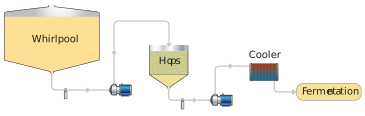
Figure: Hop back used after the whirlpool
The links below provide more details on the Braukon Hopback. Note, this is for illustrative purposes only and is not a recommendation or endorsement of the supplier’s product.