
Lesson 2 - Hop Biology and Cultivation
This lesson deals with the biology, cultivation and breeding of hops, as well as the challenges faced by both breeders and growers when bringing hops to the market. We also take an in-depth look at hop varieties and their various classifications.
Point of reflection – reconvene
Welcome back. So, what were your thoughts?
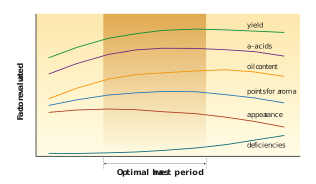
Figure: Figure: Changes in quality factors as hop cones
As the oil content increases towards the end of the harvest period, or even after, you may be inclined to harvest later. However, the ideal aroma for a specific variety is not just determined by its total oil content. The composition of the oil also determines the aroma and this changes as the cone matures. Hop appearance also deteriorates towards the end of this period, which may affect how a brewer perceives its quality.
It is important to realise that there is no single optimum time to harvest and that if the yield, α-acids and oil content are at a maximum, then it could be that the hops look tired (less green and with some browning) and deficiencies may be increasing. Great-looking hop cones may not be optimal for brewing, as the α-acids and essential oils may not be fully developed.
The article on the link below provides more information about determining the optimum time for harvesting hops.
https://journals.flvc.org/edis/article/view/130194/134217
That brings us to the end of this lesson, so let’s quickly summarise how hops are produced:
- Identify what types of hops are required to meet a specific need from the customer (e.g. brewer or farmer).
- Breed the hops to meet that need, ensuring all commercial requirements are met.
- Propagate, plant, grow, and then harvest the hops.
- Dry and stabilise the hops ready for further processing into various hop products.
We now need to understand hop chemistry in more detail. This is explored in Hop Lesson 4.