
Lesson 2 - Hop Biology and Cultivation
This lesson deals with the biology, cultivation and breeding of hops, as well as the challenges faced by both breeders and growers when bringing hops to the market. We also take an in-depth look at hop varieties and their various classifications.
Harvest and Drying
Instead, they are harvested in the midst of their growth, when their moisture content is between 75-80% and their lupulin glands are filled with resins. They should be harvested within 10 days of ripening, to prevent over-ripe cones from shattering.
Historically, hop growing was extremely labour intensive, but harvesting has now become almost fully automated. The process is as follows:
- The hop bines are cut just above the ground, pulled off the support structure, and transported to the harvest centre.
- The bines are then fed upside down into the hop picker, where the machine separates the cones from the bines (and some leaf and stem material).
- Next fans, screens and inclined conveyor belts are used to separate the leaf and stem material from the cones.
- The separated bines are chopped into mulch and composted. The compost is spread over the hop growing area.
- The hop cones are then dried in a hop kiln using warm air, at a temperature of 65°C. This reduces cone moisture from 80% to 10%. This helps to prevent the hop cones from deteriorating e.g. changing colour, developing a poor odour, or becoming mouldy.
- Next, the hops are conditioned. In conditioning the moisture level is evened out within the cones and throughout the batch. The hops are kept in a chamber at 20-24°C, with a relative humidity of 58-65%. If hop cones are not dried to 12% or below and cooled, the bales can combust!
- Finally, the hops are compressed and baled to reduce storage requirements and costs.
Point of reflection: Consider the figure below. If you were growing an aroma variety, when would you ideally harvest?
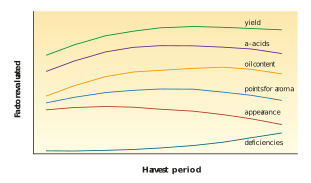
Figure: Changes in quality factors as hop cones ripen
Give yourself 5-10 mins to think about this and then click ‘Next’ to continue with this lesson.