
Lesson 2 - Hop Biology and Cultivation
This lesson deals with the biology, cultivation and breeding of hops, as well as the challenges faced by both breeders and growers when bringing hops to the market. We also take an in-depth look at hop varieties and their various classifications.
Hop Cultivation
As brewers, we are mainly concerned with what is harvested at the end of the hop growing cycle, but it is useful to take a look at how hops are grown.
- Hops are a climbing perennial plant (which means they live for more than two years thus do not need to be replanted every year).
- They are dioecious; therefore, an individual plant produces either male or female flowers.
- Only female plants are cultivated, because they alone produce hop cones.
- The male plants must be eradicated from the regions where the female plants are cultivated. This is to prevent any pollen from being released and forming seeds in the female plants.
- They are indigenous to Europe, Asia and North America.
- Although not native to the Southern Hemisphere, they have been introduced in Australia, New Zealand, South Africa and South America.
Hops need a specific period of daylight to grow. The parts of the world where these periods are available are between the 34th and 55th parallel of latitude. Hops can grow in both cool and moist regions (preferably with summer rainfall), as well as dry and arid regions (as long as they are irrigated). Low winter temperatures are required to encourage the dormancy necessary for vernalisation. Vernalisation is required for hops to flower. Hops naturally climb over other plants as they grow, so need supporting structures. Hop farmers use tall trellises, with wooden support frames and wires for the hops to use as support.
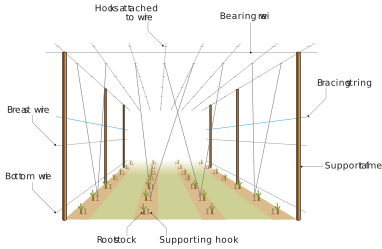
Figure: Supporting framework for hop cultivation
In South Africa, artificial light has been used to extend the effective day length. This ensures that the required period of daylight is provided. A breeding programme has been able to develop new varieties that can handle the shorter daylight hours, thus removing the need for artificial lighting for those varieties!
Before we move on to the hop growing cycle and harvesting, we should touch on the pests and diseases that can affect hops, and how they are controlled.