
Lesson 2 - Hop Biology and Cultivation
This lesson deals with the biology, cultivation and breeding of hops, as well as the challenges faced by both breeders and growers when bringing hops to the market. We also take an in-depth look at hop varieties and their various classifications.
Hop Breeding
The brewing industry is constantly changing. New beer styles are introduced, and new brewing equipment and processes are developed. These processes may require hops with unique or novel attributes, making it even more challenging for the hop breeder to identify what they are breeding for. Furthermore, in 10 years’ time, everything may have changed again! Today the development process is usually faster and the replacement of varieties much more frequent.
The areas of focus for hop development are shown in the figure below.
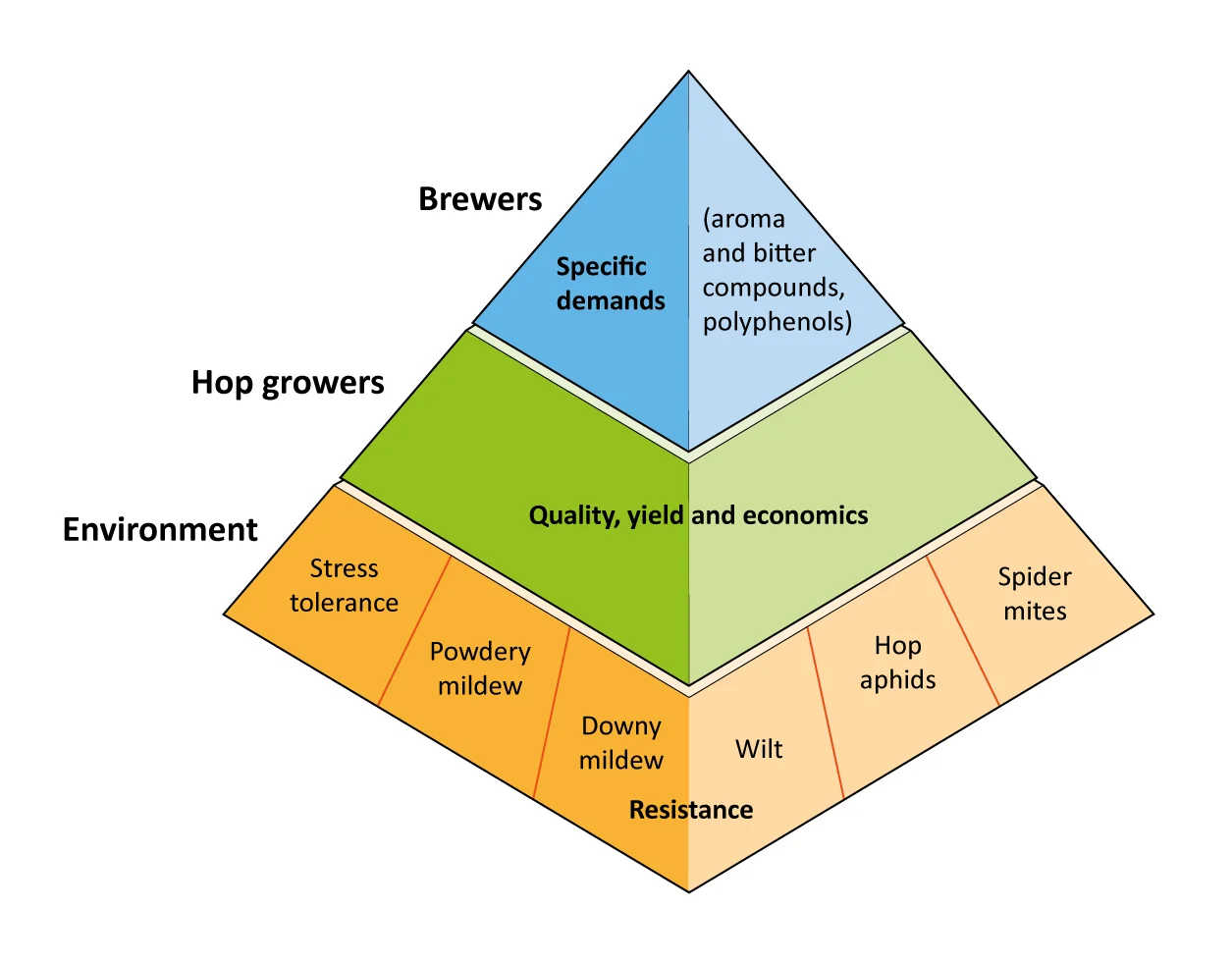
Figure: Important hop breeding goals
Hops are dioecious, which means they grow as either male or female plants. Male plants have no use in brewing and are destroyed within a three mile radius of hop farms, in order to prevent unwanted natural pollination. Pollination of a variety by a wild hop or another variety produces hop plants of a new variety that is unlikely to have the required attributes. It also produces seeds that are at best of no value to us brewers.
The breeding methods are:
- Selective breeding (clonal selection) – selecting the best and most robust plants for propagation, to maintain purity of a single variety.
- Crossbreeding – selecting different varieties with desirable attributes, to provide hops with the desirable attributes of both.
A hop breeding programme consists of: preparing pollen; making controlled crosses; raising seedlings; transferring seedlings to the field and collecting; drying; and pressing cone samples from the seedlings for analysis.
Each breeding programme has its own nuances and timelines, but an example of a hop breeding cycle is shown below:
Year 1: Create variety crosses (around 40 – 50 crosses)
Year 2: Raising seeds (15,000 – 25,000 seedlings)
Year 3: First assessment of individual seedlings (based on resin analysis, and aroma assessment)
Year 4: Mature hop harvesting; yield, plant health and cone shape
Year 5: Selection of potential varieties and propagation of material for commercialisation
Year 6: Planting of small plots
Year 7: Assessment of commercial attributes including suitability for machine harvesting, yield, oil and resin analysis, and disease resistance
Year 8: Assessment of mature plants for habit (growth characteristics) and pilot brewing trials
Year 9: Propagation of materials for planting on farms
Year 10: Planting on farms
Year 11: Commercial crop
Today, as brewers often seek novelty, and in turn require a flow of new varieties, some new hop breeding programmes are less concerned with developing improved resistance to disease or high yields. It is thus unlikely that most of these varieties will be grown extensively or remain available for very many years. The intent is often to replace them within just two to three years.
Commercial pressures such as the demand for new varieties has led to short cutting the development process.
An example of how breeding can benefit hop growers is the great success of the Wye Hops Ltd. breeding programme and their development of dwarf hop varieties.
We have looked at hop breeding from the point of view of the brewers/growers/market, but how are hops actually cultivated?