
Lesson 2 - Hop Biology and Cultivation
This lesson deals with the biology, cultivation and breeding of hops, as well as the challenges faced by both breeders and growers when bringing hops to the market. We also take an in-depth look at hop varieties and their various classifications.
Hop Botany
Commercially cultivated hops are classified as Humulus lupulus L., part of the Cannabinaceae Family. Another member of this family is cannabis. Please note that hops do not have the same psychoactive resins found in marijuana!
Many people think the hop cone is the flower of the hop plant, in fact it is the fruit bearing part of the plant. The hop cone is known as the strobilus. The strobilus consists of a central strig (stalk) with two bracts (leaf-like structures) and four bracteoles (smaller leaf-like structures) attached.
What we call seeds are in fact the achene (fruit) of the hop that contains the seed. They are a bit like the little pips you find on a strawberry. While it is not strictly correct, brewers always just call them seeds.
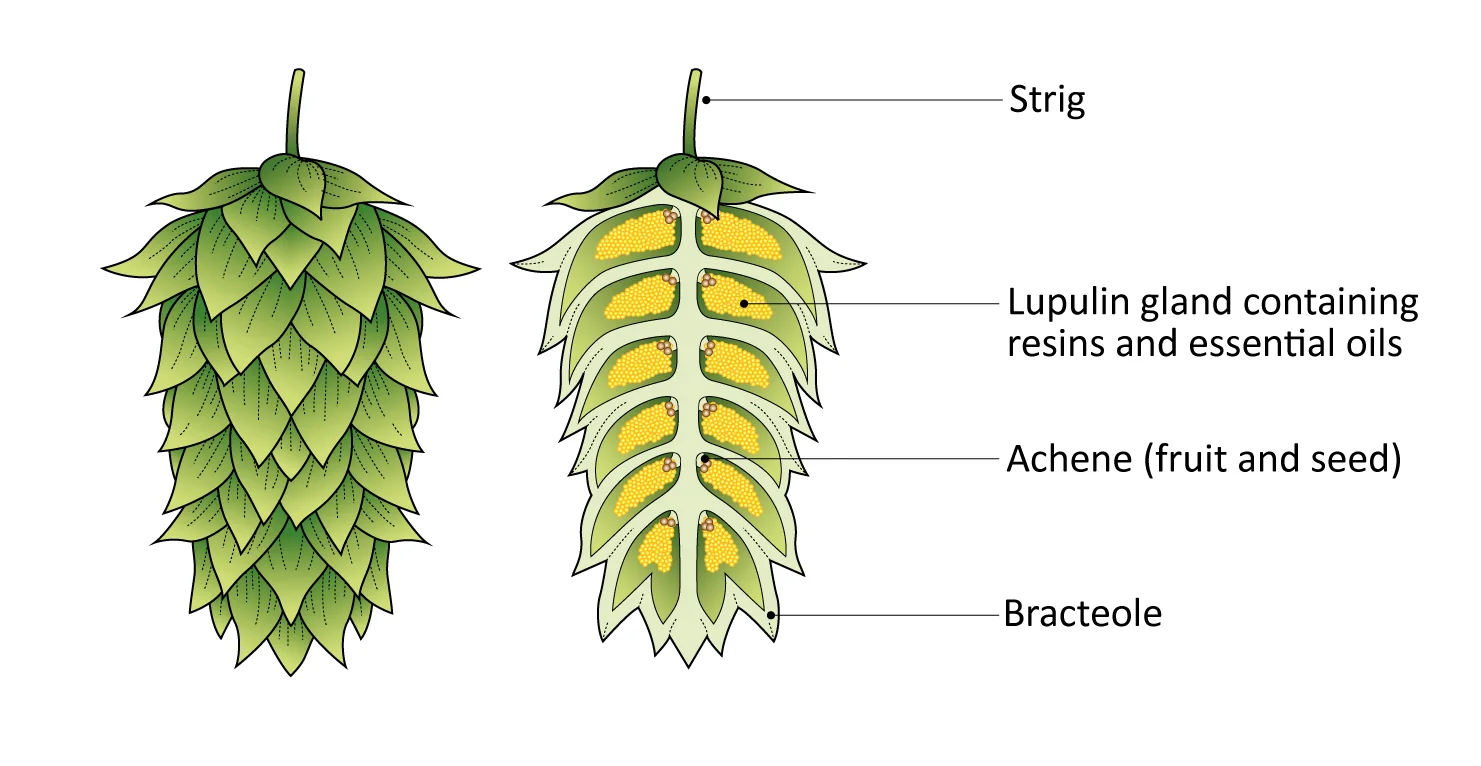
Figure: Hop cone and its constituent parts
The lupulin glands produce the bitter and aromatic compounds used in brewing.
But what about the rest of the hop?
The following table gives a representative composition of a hop cone (can also be referred to as whole hop). We use representative because the level of constituents varies between varieties, crop years and growing areas.
Table: Chemical composition of a hop cone
|
Constituent |
Amount (% w/w) |
| Lipids | 2-5 |
|
Total resins |
15-30 |
|
α-acids |
2-18 |
|
β-acids |
2-14 |
|
Essential oil |
0.5-3 |
|
Proteins |
15 |
|
Monosaccharides |
2 |
|
Polyphenols |
4 |
|
Pectins |
2 |
|
Amino acids |
0.1 |
|
Waxes and sterols |
Trace |
|
Ash |
8 |
|
Moisture |
10 |
|
Cellulose, etc. |
43 |
You may notice that the total resins only make up between 15- 30% of the hop cone, with the essential oils contributing just 0.5-3%. While not usually on a hop supplier’s analysis sheet, some of the other compounds also play a role in the brewing process.
For example some can act as a filter medium when using a hop back (refer to Hop Lesson 8). Furthermore, polyphenols affect flavour and colloidal stability, as well as mouthfeel.