
Lesson 8 - Process Control and Instrumentation End of Unit SAQ
This lesson allows you to test yourself on the material covered in the Process Control and Instrumentation unit and determine the level to which you have met the learning outcomes.
Suggested Response - Q2
*** You have been asked to control the dilution water addition that is added in-line on route to the bright beer tank.
a) Name two control configurations you could consider using to achieve this. What are the advantages and disadvantages of each?
b) What are the instrumentation and control elements required in each system? Draw a diagram of them.
c) What type of PID control would you recommend for each of these?
Response:
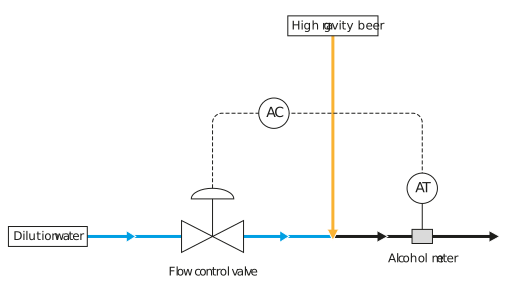
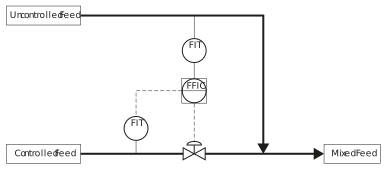
a) There are two options. We could use feedback control, measuring the alcohol in-line and using this to control water addition. Alternatively, we could use ratio control, using the flowrate of the beer stream to provide a setpoint for the addition of dilution water. This is then controlled with a feedback loop to a flow control valve.
b) For feedback control, we would need an alcohol meter and a control valve for water flow:
For ratio control, we would need a flowmeter for beer, another flowmeter for water, and a control valve for water flow.
c) For ratio control, we should ideally use PI control with a low controller gain and a low integral time to ensure the integral term is larger than the proportional term. This situation cannot tolerate any offset and thus the integral term is absolutely required. Flow measurement and control is inherently noisy, and the reaction is fast, hence derivative control is not advisable. The recommendation would be similar for feedback control using alcohol measurement.