
Lesson 2 - Principles of Process Control
This lesson explores exactly what process control is and explains why it is important. It examines the various levels within process control systems and identifies the associated equipment. It also takes a detailed look at the various automation communication and control elements.
Process Control Automation Systems
Control systems come in a wide variety of forms. Each form contains different levels of control.
Let us look at the hierarchy of control first. The figure below shows the typical hierarchy:
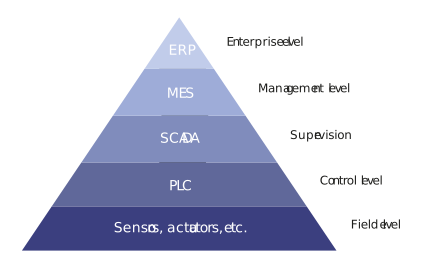
Figure: Typical hierarchy of process automation
We will now briefly examine these terms, starting at the bottom and working our way up.
Field level
The field level of automation refers to the elements within the process. Both the sensors and instruments measure what is happening in the process; the control elements used to control the process sit at this level. Examples include sensors and actuators. An example of this is a level switch that senses a high level in a tank and an actuator that opens or closes the valve used to fill the tank.
Control level
The next level up is where the control actually happens. For many processes, this is done through a programmable logic controller (PLC). PLCs have an ever-increasing range of capabilities. A PLC can be seen as a robust industrial computer. They typically consist of a CPU (central processing unit), power supply, input modules, and output modules. They are usually programmed with an external programmer. The figure below shows a typical traditional PLC configuration:
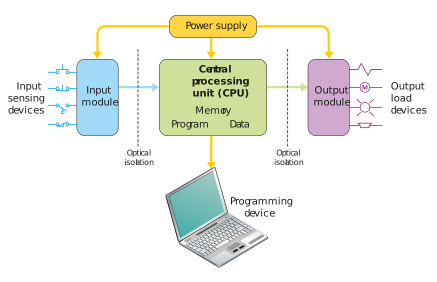
Figure: Typical PLC configuration
The CPU continuously loops, or scans, through the process and checks the various inputs and outputs against the programme. You will thus often hear the scan time of a PLC mentioned.
Various different PLC programming languages can be used. “Ladder logic” is one the most common ones.
PLCs cannot conduct complex calculations. Furthermore, they do not have display capability.
A network of PLCs is referred to as a DCS (distributed control system). PLC capability has increased to the point where a single PLC can cover more areas of a process than ever before.
At the control level, another option is to use a PC (personal computer) or an IPC (industrial personal computer). The table below compares the two systems:
Table: Comparison of a PLC vs a PC
|
|
PLC |
PC |
|
Processing time |
Faster scan time Not suited for complex calculations |
Slower scan time Can do complex calculations |
|
Robustness |
High - unlikely to go wrong |
Low - more likely to go wrong |
|
Security |
Less susceptible to attacks |
More susceptible to cyberattacks |
|
Links to Inputs and Outputs |
Easy |
More complex |
|
Ability to Control PID Loops |
Built-in |
Not as easy – may require stand-alone controllers |
|
HMI (Human Machine Interface) |
Another layer required |
Built-in (to a PC) |
|
Memory and Data Storage |
Low |
High and built-in |
|
Maintainability |
Easy to service |
More difficult |
As it very much depends on the process, you will see that cost has not been included in this table.
Standalone controllers can control individual variables. They act independently or semi-independently of the higher-level controller. They can be in the form of mini PLCs, with built-in controls and setpoints, either entered manually or communicated from the main control system.
Another form of controller is a programmable automation controller (PAC). This is a hybrid of a PLC and a PC because it is physically more in line with a PLC, but uses more sophisticated programming languages.
Supervisory level
If we consider the control level to be an automatic process, then the supervisory level is the point from where this automatic process is controlled. The main component of the supervisory level is normally a SCADA (supervisory control and data acquisition), which also acts as the main HMI (human machine interface). The SCADA system is usually responsible for the display of the process, the input of recipes, and other operator interactions. The status of the plant and its alarms are also displayed here. It is often seen in the control rooms of larger breweries.
Archiving and trending also happen at this level. Information may be recorded and stored in a separate server designed for this purpose.
For more details on SCADA systems, refer to the following article. Note, this is for illustrative purposes only and is not a recommendation or endorsement of the supplier’s product:
https://www.plcacademy.com/scada-system/
In smaller breweries, the supervisory level can be integrated into the control level using PC based controls.
Management and information or enterprise levels
These are the levels where information goes beyond automation and sends information into financial and management systems. Examples of this would be the upload of the amount of malt used in a batch into an enterprise resource system (ERP), such as SAP, which allows us to record the consumption of raw materials in real time.
MIS/MES (management information/execution systems) can allow management personnel to use information from the control system in a meaningful way to help them optimally manage the process. These systems can extract information into reports and dashboards that are accessible on different platforms. Everything from beer loss to machine efficiencies and quality results could form part of this. As you can imagine, this is valuable to larger breweries or groups consisting of multiple breweries. However, the cost and complexities of these systems would make them difficult and less profitable for small brewers to use.
Now that we have a view of the entire system, we will now look more closely at how all these components communicate.