
Lesson 2 - Principles of Process Control
This lesson explores exactly what process control is and explains why it is important. It examines the various levels within process control systems and identifies the associated equipment. It also takes a detailed look at the various automation communication and control elements.
Batch and Continuous Processes
Processes are classed as either continuous or batch.
A batch process is one where a finite quantity of product is produced by processing quantities of input materials to a sequence of steps, all performed in a defined order. It can use one or more pieces of equipment.
A continuous process is one where raw materials are continuously added and the product continuously flows through the process until the final product comes out the other end.
The figure below shows the two processes:
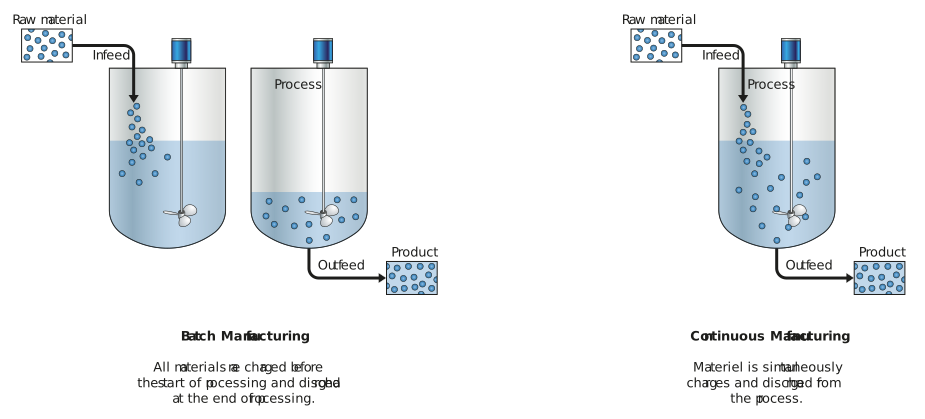
Figure: Examples of batch and continuous processes
However, brewing is generally a batch process. Batch processes bring two distinct advantages to food and beverage production. The first is that each batch can be different to allow for different brands. The second is that traceability is far better in batch processes.
True continuous processing is used for plants such as refineries, which run continuously and hardly ever stop.
You may be wondering why we are focusing on batch vs continuous processes? The reason is that different forms of control are required for each process. Think about a batch process like baking a cake. You need many different steps, and controls within each step. However, when we look at a continuous process, we have many controls that run continuously. An example of continuous control in our everyday lives would be the supply of potable water to the taps in our houses.
Brewing has elements of continuous control in it as well. Consider a process like filtration: a filter may run for an extended period, even though it is processing different batches.
Process control standards
As you can imagine, there are many ways to control a process, so the International Society for Automation brought out the S88 standard for batch control in 1995.
The S88 provided a system for controlling a batch and in essence relates three models to each other:
-
The process model, which is defined by the material and what happens to it.
-
The physical model, which looks at the equipment used.
-
The procedural control model, which looks at the software.
The figure below shows how they relate to each other:
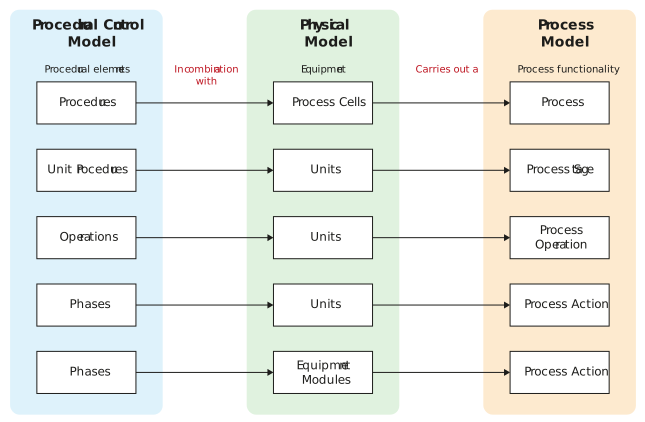
Figure: S88 models
S88 provides standards as to how the procedural models are set up and operate. So, whilst recipes are unique to a manufacturer, their equipment and the way their recipe is structured, will be similar provided they adhere to the standards.
To find out more about the S88 standard, please refer to the following. Note, this is for illustrative purposes only and is not a recommendation or endorsement of the supplier’s product:
https://www.plcacademy.com/isa-88-s88-batch-control-explained/
Another standard, S95, focuses more on the enterprise level, which sits above the units. So, whilst S88 is focussed on what happens with a batch, S95 focusses on the exchange of information between the lower levels of control and the higher levels of control, and not the control thereof.
A later addition to the standards is S106, which deals with continuous processing. This standard focuses on what happens at the physical control level.
For more information on S106, we recommend that you read the following article. Note, this is for illustrative purposes only and is not a recommendation or endorsement of the supplier’s product:
https://web-material3.yokogawa.com/ISA_106_TR1_Infographic.us.pdf