
Lesson 7 - Electricity SAQ
This lesson allows you to test yourself on the material covered in the Electricity lesson and determine the level to which you have met the learning outcomes.
Suggested Response - Q5
** a) What is power factor?
b) How does power factor differ for inductive, resistive, and capacitive loads?
c) What is power factor correction and why is it important?
Response:
a) Power factor is the ratio of true power to apparent power. True power is the actual power drawn by a piece of equipment, and is measured in kW. Apparent power is the power applied, and is measured in kVA. The reason for the difference is reactive power, which is measured in kVAr.
b) Loads such as heating elements and light bulbs are resistive loads, as the load depends on the resistance of the equipment. All the power must go through the equipment, and the voltage and current drawn are perfectly in phase, and thus the power factor is one. Therefore, all the power applied is turned into useful energy. However, if we have an inductive load such as the load from an inductive motor, the power applied ‘induces’ rotation. Here, the current lags the voltage because the electromagnetic field created causes the current to lag behind the voltage applied. This is what happens in most industrial applications. Another form of load is a capacitive load. A capacitor can be seen as a ‘storer’ of electricity. In this case, the current leads the voltage. These three examples are shown in the figure below.
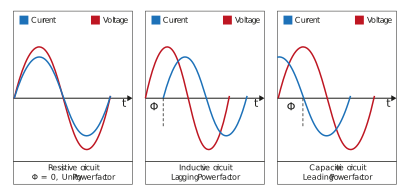
Figure: Unity, lagging, and leading power factors
c) Power factor correction is done by using devices that add capacitive load to bring the voltage and current back into phase, or as close as possible to it. Users are charged for the power supplied, and thus a low power factor means paying for power you have not used. A brewery has many motors and thus could have a low power factor, so power factor correction is very important.