
Lesson 11 - Jacketed Vessels SAQ
This lesson allows you to test yourself on the material covered in the Jacketed Vessel lesson and determine the level to which you have met the learning outcomes.
Suggested Response - Q3
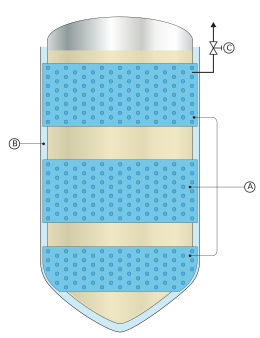
*/** The vessel in the figure below contains three key features of a jacketed vessel. What are these features, and how does each one improve the effectiveness of heat transfer in a jacketed vessel?
Response
The following three features are highlighted in this figure above:
a) Multiple jackets (in this case three)
b) Insulation
c) Jacket vent
a) Multiple jackets
Multiple jackets improve the effectiveness of heat transfer by providing the ability to vary the effective heat transfer area of a vessel. This can be beneficial in the following heat transfer scenarios:
-
Where varying heat transfer rates are required, but for specific reasons the utility fluid flowrate cannot be varied, e.g. it has only ‘on/off’ control. When a lower heat transfer rate is required, jackets can be switched off and then on again when a higher heat transfer rate is required.
-
If the volume inside the vessel is variable, multiple jackets can be used to only heat or cool the portion of the vessel covered by product. This saves energy and also prevents fouling of the heat transfer surface.
b) Insulation
Insulation improves the effectiveness of heat transfer by ensuring that maximum energy is exchanged between the product and utility fluid rather than being ‘wasted’ into the surroundings.
c) Jacket vent
The jacket vent improves the effectiveness of heat transfer by allowing any accumulated non-condensable gases to be vented from the jacket. Non-condensable gases are poor conductors of heat and if allowed to accumulate in the jacket, they will lower the heat transfer effectiveness of the vessel.