
Lesson 13 - Control of Fluid Flow 3 SAQ
This lesson allows you to test yourself on the material covered in the Control of Fluid Flow 3 lesson and determine the level to which you have met the learning outcomes.
Suggested Response - Q3
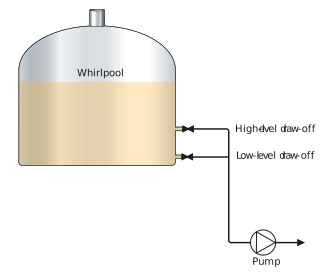
**/***A small brewery's whirlpool is fitted with high- and low-level wort draw-off lines connected to a centrifugal cast-out pump as shown in the figure below. The high-level line alone is used to initially draw clarified wort from the whirlpool whilst the remainder of the body of wort in the whirlpool continues to clarify. Once the working level in the whirlpool drops to the high-level line, the draw-off process is switched to the low-level line. Wort flow rate modulating control is required of the pumped wort flow from the whirlpool. The plant layout is shown below.
a) Specify the type, or types of valve control function you would require for the whirlpool and where would you put control valves?
b) What valve types would you consider for the various valve positions and functions you specified in part a)?
Response:
a) We are told that during the draw-off of clarified wort the high-level line alone is to be used to draw clarified wort from the whirlpool whilst the remainder of the body of wort in the whirlpool continues to clarify. Once the working level in the whirlpool drops to the high-level line, the draw-off process would be switched to the low-level line. Alarms bells should be ringing here as on-off control is required for both of these lines. Accordingly, we will use two on-off control valves, one in each of the draw-off lines. The figure below shows the positioning of the valves.
As for the type of valve we could use, it would either be a butterfly or a ball valve.
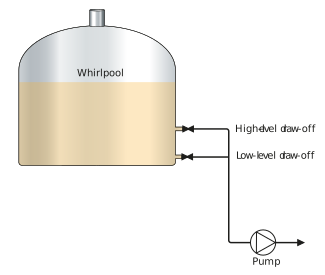
b) We are told that modulating flow rate control is required of the wort flow from the whirlpool, so somewhere we will use a modulating control valve, but where will we put it? It may be tempting to use the on-off valves in the draw-off lines, to regulate flow, but both of these valves are on the suction side of the pump. Reducing pressure in the suction line, by throttling the flow through the valves, is not good practice, particularly if we note that the wort will be at a temperature very close to its boiling point. Such practice in this situation could cause the pump to cavitate. It would be required to position the valve on the discharge side of the pump.
A globe valve could be used to control the wort flow rate, but depending on the size of the pipeline, it may be too expensive. A standard butterfly valve could be used, to keep things simple, but it may have crude control characteristics, in which case a modified butterfly (offset spindle) could be considered.