
Lesson 13 - Control of Fluid Flow 3 SAQ
This lesson allows you to test yourself on the material covered in the Control of Fluid Flow 3 lesson and determine the level to which you have met the learning outcomes.
Suggested Response - Q1
*/**A pump is to be fitted with two isolation valves: one each in the suction and discharge lines. The purpose of these valves is to allow the pump to be isolated from the line, by fully shutting off the pump from the lines so that scheduled maintenance can safely be conducted on the pump.
a) What flow rate characteristic would you require of these valves?
b) Suggest and justify a valve type or types which would be suitable for this application.
c) Would you suggest any particular work instruction associated with these valves as a part of routine maintenance?
Response:
a) The purpose of the valves is to shut off the flow to and from the pump during maintenance. This is so the pump can be removed from the line or inspected without the risk of liquid accidentally flowing into the pump (and on to the maintenance personnel). We only require the valves to shut the flow off or allow flow to pass unhindered, i.e. we only require an on-off function, rather than a flow modulation function. The flow characteristic which would suit this function is one of fast opening as shown in the figure below.
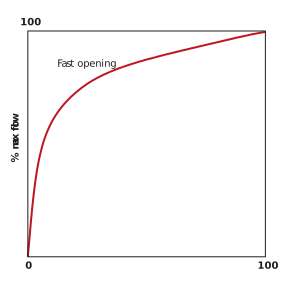
b) As we only require an on-off function, we could consider the following valve types: butterfly, ball, and gate valves. Globe valves would not be likely to be considered, as their function as a modulating valve would be unused.
Final selection would be made based on cost, availability, and consideration of the particular liquid within the line, e.g. product versus utility liquid, compatible material, and hygiene requirements.
c) You may have come up with a variety of work instructions here, depending on your experience, which may address aspects which we have not covered in the learning material so far. These might include various safety, health, and environment requirements such as permit-to-work, valve lock-out procedures, and line depressurisation and drainage.
One of the key things that we would be concerned about from a fluid mechanics perspective would be the resetting of both valves back to fully open, following maintenance, to ensure that the pump suction and discharge are not needlessly throttled. Remember, in previous lessons, we considered the impact of excessive suction line pressure drop and its impact on pump cavitation.