Lesson 13 - Control of Fluid Flow 3 SAQ
This lesson allows you to test yourself on the material covered in the Control of Fluid Flow 3 lesson and determine the level to which you have met the learning outcomes.
Self-Assessment Questions
1. */**A pump is to be fitted with two isolation valves: one each in the suction and discharge lines. The purpose of these valves is to allow the pump to be isolated from the line, by fully shutting off the pump from the lines so that scheduled maintenance can safely be conducted on the pump.
a) What flow rate characteristic would you require of these valves?
b) Suggest and justify a valve type or types which would be suitable for this application.
c) Would you suggest any particular work instruction associated with these valves as a part of routine maintenance?
2. ***You are the cellar manager at a brewery where fermenter overpressure protection is achieved using spring-loaded mechanical pressure relief valves. An alternative option being proposed by a vendor is the use of bursting discs. What would your initial thoughts be on such a system? Give justifications.
(This is quite a far-reaching question. Try some searching on the internet and also discuss with brewery employees if you have a chance.)
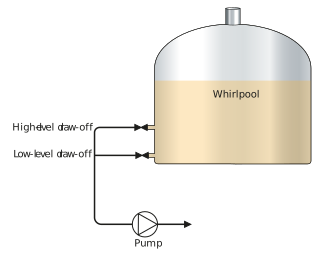
3. **/***A small brewery's whirlpool is fitted with high- and low-level wort draw-off lines connected to a centrifugal cast-out pump (as shown in the figure below). The high-level line alone is used to initially draw clarified wort from the whirlpool whilst the remainder of the body of wort in the whirlpool continues to clarify. Once the working level in the whirlpool drops to the high-level line, the draw-off process is switched to the low-level line. Wort flow rate modulating control is required of the pumped wort flow from the whirlpool. The plant layout is shown below.
a) Specify the type, or types of valve control function you would require for the whirlpool and where would you put control valves?
b) What valve types would you consider for the various valve positions and functions you specified in part a)?
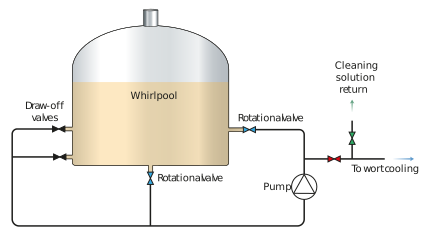
4. **/***The figure below shows a schematic for a whirlpool in a small craft brewery. Only one pump is used to fill and rotate the whirlpool and also pump-out the whirlpool to wort cooling. This minimises the number of pumps required – the pipework and valving is as shown below. Blue rotational valves are used to ‘spin’ the wort in the whirlpool and to achieve its dual-purpose function. Following the required rest period, where the trub would begin to sediment, the black draw-off valves are used to feed wort to the suction of the pump and the red wort cooling valve is opened to allow clarified wort to be pumped to wort cooling.
Cleaning-in-place of the wort main and wort cooler (not shown) is done in the reverse direction, and the cleaning solution is returned via the green valve shown. It is required to be able to clean the wort main whilst the whirlpool is in-service and clarifying wort.
Review the schematic and comment on any concerns you may have on the simultaneous cleaning of the wort main and wort clarification in the whirlpool. What changes would you make to the plant to address your concerns whilst still ensuring simultaneous operation?