
Lesson 9 - Control of Fluid Flow 1 SAQ
This lesson allows you to test yourself on the material covered in the Control of Fluid Flow 1 lesson and determine the level to which you have met the learning outcomes.
Suggested Response - Q4
*/**Describe the principle of operation of a centrifugal pump with reference to Bernoulli’s equation and pump geometry.
Response:
A centrifugal pump has an impeller mounted on the end of a horizontal shaft, which is typically driven by an electric motor. The impeller rotates within a stationary casing, which has a gradually increasing section with a single tangential outlet.
Liquid is fed onto the centre of the rapidly rotating impeller and is thrown outwards, with increased kinetic energy, due to the centrifugal force generated by the rotation.
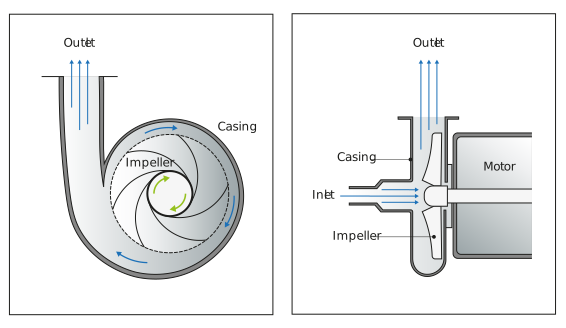
The gradually increasing section of the casing (or stator) reduces the velocity. This is described by the continuity equation below, in which mass flow rate G is conserved through the casing and for a constant density, the increasing section area A between section one and two will result in the velocity u reducing.

As the velocity u reduces, we know from Bernoulli’s equation (below) that assuming a constant density the kinetic energy (ρu²/2) will reduce. If we ignore any small change of vertical distance h through the casing, then any reduction in kinetic energy must be compensated by an increase in pressure energy and hence pressure P.
