
Lesson 9 - Control of Fluid Flow 1 SAQ
This lesson allows you to test yourself on the material covered in the Control of Fluid Flow 1 lesson and determine the level to which you have met the learning outcomes.
Suggested Response - Q3
*/**If a pump can deliver a total head of 10 m of water and with reference to the three scenarios shown below, determine the maximum heights of water above the pump outlet that the pump can deliver in the second tank (pipeline pressure losses can be ignored). You should assume that the water level in Tank 1 is maintained at the height specified for each scenario with water from another source during these transfers.
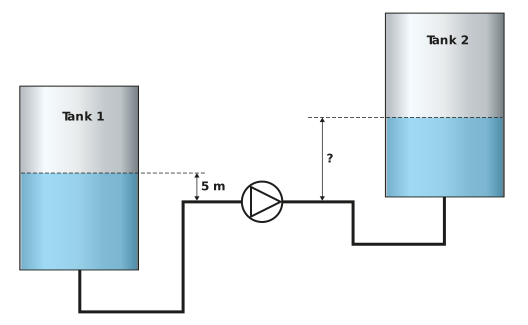
Scenario one – water level in tank 1 is 5 m above the pump inlet
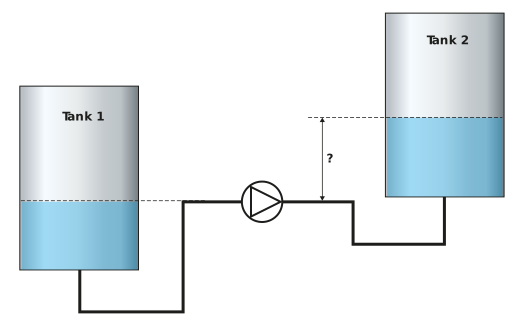
Scenario two – water level in tank 1 is at the level of the pump
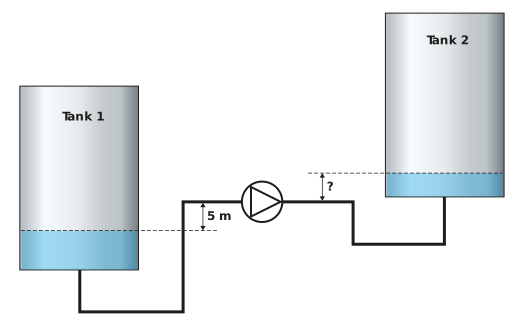
Scenario three – water level in tank 1 is 5 m below the level of the pump (Note: assume pump is self-priming, or that inlet line remains flooded)
Response:
In all scenarios, we are dealing with the concept of total head of a pump. Remember that total head is the head which a pump can develop between its suction (inlet) side and its discharge (outlet) side.
Scenario one
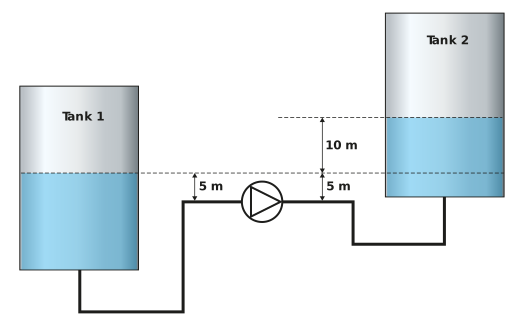
Let us consider the level of water in tank one extended into tank two (in the figure above). Does the pump need to do any work, or create a suction head, in getting water to that level in tank two? The answer is no because the 5 m head on the suction side of the pump will produce a 5 m head on the discharge side of the pump (remember we are ignoring any pressure or head losses in the pipework). After that, any head generated by the pump will increase the level in tank two by a further 10 m, so the maximum head in tank two, relative to the pump level, will be (5 + 10 =) 15 m.
Scenario two
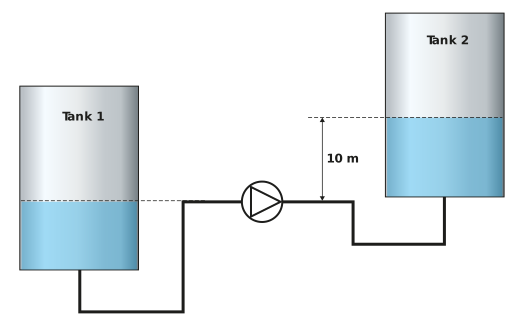
By a similar logic to scenario one, the pump will only need to generate a head to pump the water above its outlet level, as the level in tank one is at the pump inlet. Therefore, the total head of the pump will increase the level in tank two by 10 m, so the maximum head in tank two, relative to the pump level, will be (0 + 10 =) 10 m.
Scenario three
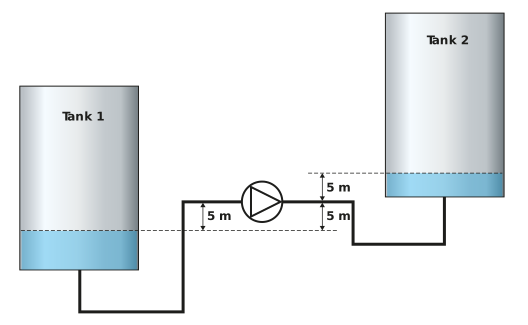
With the level in tank one being below the pump inlet, the pump will need to do some work or expend some of its total head, to draw the water into its inlet. Note the assumption that inlet line is flooded – possibly by self-priming (otherwise no water would be drawn into pump at all!) How much total head will be expended doing this? Well, 5 m of water, which will only leave 5 m of total head to discharge water into tank two and build up a head of 5 m above the pump outlet.