
Lesson 9 - Control of Fluid Flow 1 SAQ
This lesson allows you to test yourself on the material covered in the Control of Fluid Flow 1 lesson and determine the level to which you have met the learning outcomes.
Suggested Response - Q2
**The two pumps described in question one above are used to pump water against a constant head of 4 m, which may be considered independent of flow rate. If the suction head on the pump is zero, what capacities (flow rates) would a single pump and both pumps be able to generate? And what would the electrical power be for both situations? (The density of water is 1,000 kg/m3).
Response:
As the suction head is zero, and the pumps are required to pump against a constant 4 m head, the total head that the pump (or pumps) need to generate is (4 – 0 =) 4 m.
This is a case of plotting a single operating point on a pump curve and determining the resulting capacity and efficiency for both pump curves. This is shown below for both the total head and efficiency curves:
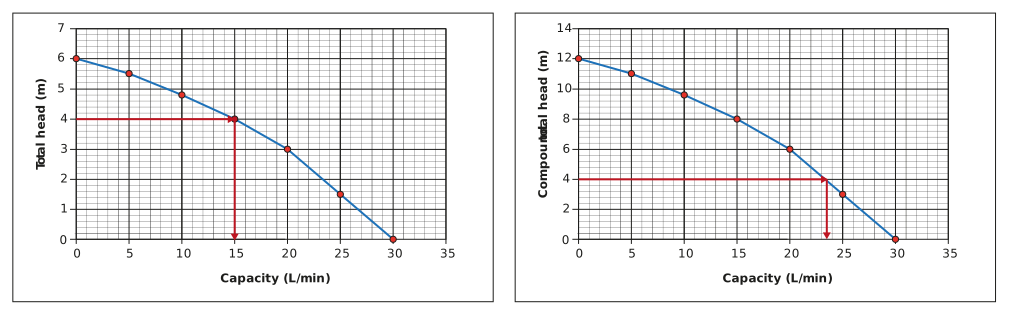
Figure: Capacity and total head pump curves for a single pump (left) and compounded for both pumps (right)
From these pump curves, the capacity at the operating points are 15 and 23 L/min, respectively. It is worth noting that running a duplicate pump in series, in this case, does not produce double the capacity.
Taking these two capacities and plotting them on the capacity-efficiency curves gives the following:
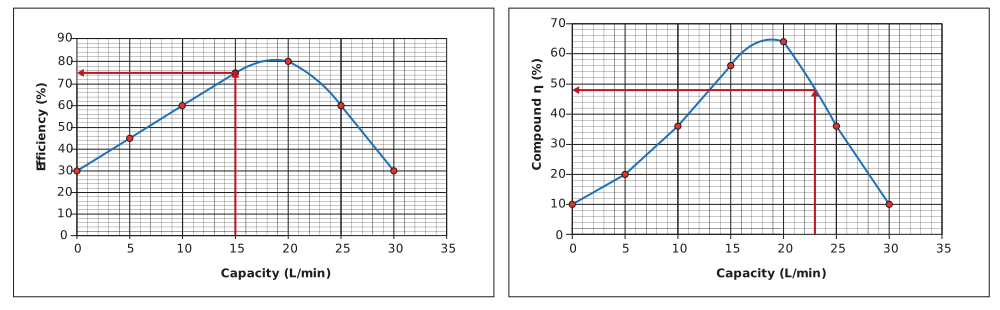
Figure: Capacity and efficiency pump curves for a single pump (left) and compounded for both pumps (right)
From these pump curves, the efficiencies at the operating points are 75% and 48%, respectively.
To calculate the electrical power drawn by the pumps, we need to calculate the respective pumping powers and then apply the efficiencies:
We know that pumping power is given by:

Where capacity Q must be in m³/s and total head ∆P must be in Pa:

And:

Converting head:

Hence the pumping power for a single pump is given by:

And for the pumps in series:

Applying the two different values of efficiency to determine the power drawn by the motor:

And for the pumps in series:

If we compare the compound electrical power drawn by the pumps in series, it is nearly three times as much as that for a single pump, yet the pumps in series are delivering less than double the capacity of that of a single pump. This is largely because of the operation of the pumps in series being well away from the operating point of maximum efficiency.
In practice, we would likely consider using a single pump if the capacity was sufficient for our process needs. If we required greater capacity than a single pump could deliver, we could consider a replacement pump which had a higher efficiency at the required operating point. As ever, process economics would have to be considered, and the capital cost of a lower running cost pump would have to be compared.