
Lesson 3 - Quality Management SAQ
This lesson enables you to test yourself on the material covered in the Quality Assurance and Quality Management Lesson
Suggested Response - Q3
**You have just taken over as HACCP lead from a colleague. You consult the HACCP plan and you discover there are 32 CCPs. Look through the four which are detailed below and explain how you can reduce the number.
Response:
a) CCP: Handwashing on entry to bottling: critical limit minimum 30 seconds of lathering
This can be crossed off the list on the basis that any hazard from unwashed hands would be controlled by the pre-requisite programme for hygiene. In this all staff would be trained and assessed on the correct procedure for hand washing. Facilities would be in place to enable them to wash their hands effectively. An induction programme for visitors would ensure they also understand what is required.
b) CCP: Mill room knife inspection: critical limit blade intact after each bag is opened
This hazard will be controlled in part by a pre-requisite programme for managing sources of foreign bodies but not enough for that alone to stop it being a CCP. We need to refer to a decision tree to check its status as a CCP; before doing so it is worth noting that the intactness of a blade is not an adequate critical limit as it is not a quantitative measure.
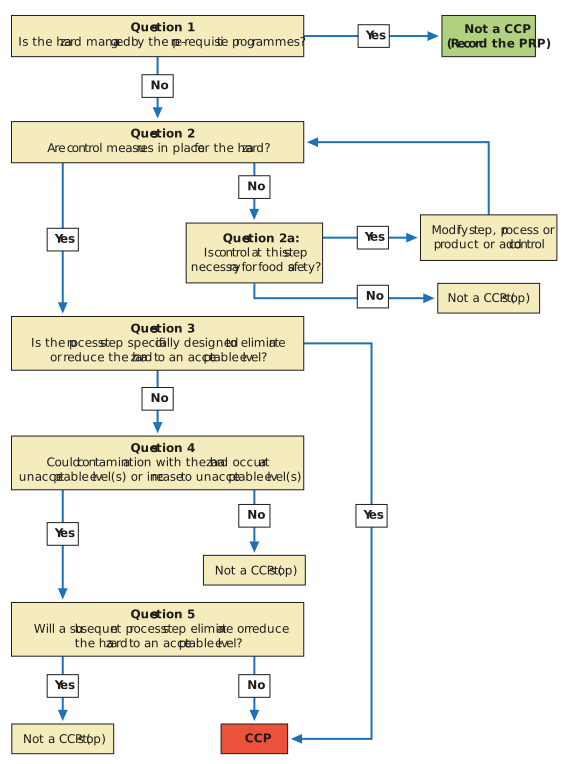
Figure: HACCP decision tree
Working through the decision tree, the answer to ‘are control measures in place for the hazard?’ is yes; the answer to ‘is the step specifically designed to eliminate or reduce the hazard to an acceptable level?’ is no; the hazard could reach unacceptable levels if someone found a bit of knife blade in their beer so the answer to that is yes; and the answer to ‘will a subsequent step eliminate the hazard?’ is yes as there are at least three screening methods which would remove the knife blade (mill magnet, screens in wort separation, hop strainer before wort cooler) before beer is packaged. It can therefore be crossed off the list of CCPs.
c) CCP: Glycol pressure in pre-filtration PHE beer chiller: critical limit minimum 0.5 bar Dp between process fluid and glycol
This is a common CCP in breweries and for good reason. Working down the decision tree the answer to the first two questions is yes, leading to confirmation that this is a CCP. The CCP has a measurable and quantifiable critical limit so can remain in the HACCP system.
d) CCP: Water supply to cask ale brewery: critical limit maximum coliform bacteria 1CFU
This is very unlikely to be a CCP. A subsequent step like heating the water above 72 °C for 5 minutes, UV or ClO2 treatment, or sterile filtration is likely to remove the hazard. Beer’s natural resistance to pathogenic organisms is also likely to remove the hazard. Although alcohol-free beer does not have the same in-built protection, the CCP refers specifically to cask ale (which isn’t alcohol-free) so that is not an issue here. In any case, the critical limit is inadequate because quantification of CFUs of microorganisms takes several days so it cannot be measured in real time.