
Lesson 2 - Quality Assurance and Quality Management
This lesson looks at the management of quality both generally and in the brewery. It discusses definitions of quality and then explains and compares approaches to quality control and quality assurance. Next, it details the components of a formal quality management system as well as tools used in quality management. Finally, it explains what tools are available for the systematic management of food safety and product integrity, and considers how these apply in the brewing industry.
HACCP continued
Stage 4. Conduct a hazard analysis (HACCP Principle 1)
At this stage we analyse the hazards that we have identified from the process flow diagram. The analysis gives us a risk rating from each of the hazards identified. Risk is calculated on the basis of the hazard’s impact multiplied by the likelihood of that hazard occurring in the product. The figures below show how the ratings of both impact and likelihood are developed.
Table: Impact rating
|
Impact Rating |
Impact |
Definition |
|
1 |
Low |
Consumption of the hazard might cause consumer disgust, but will not have any significant adverse physical health effect |
|
3 |
Moderate |
Consumption of the hazard might cause a mild adverse physical health effect, or it might cause a health effect if the consumer is consistently exposed to the hazard over a long period of time |
|
5 |
Severe |
Consumption of the hazard might cause severe physical problems in some people |
Table: Likelihood rating
|
Likelihood Rating |
Likelihood |
Definition |
|
1 |
Low |
The hazard is present intermittently and if control of the product was absent at this point the hazard would be present in only one part of one batch of the product |
|
3 |
Moderate |
The hazard is present intermittently and if control of the product was absent at the this point the hazard would be present in the whole of one batch of the product |
|
5 |
Severe |
The hazard is present continuously and if control of the product was absent at this point the hazard would affect several batches of product. |
As an example, we consider dust floating in the air when a door is opened to packaging. Dust in beer is only likely to cause disgust in a customer so will have an impact rating of 1. As it is only around when the door is open it is present intermittently in one batch and hence has a likelihood rating of 3. If we multiply 1 by 3 we get a risk rating of 3. We would only consider risk ratings of 5 or over as significant. Broken glass in a bottle would have a 5 x 3 rating so would be included in the HACCP study.
Once ranked, the HACCP team identifies the appropriate control for each hazard either from the PRP or from a CCP.
Stage 5. Determine the CCPs (HACCP Principle 2)
We define a CCP as a step or procedure in the brewing process where control is essential to prevent, eliminate, or reduce a hazard to an acceptable level. To establish if a hazard should be a CCP we use the HACCP decision tree below:
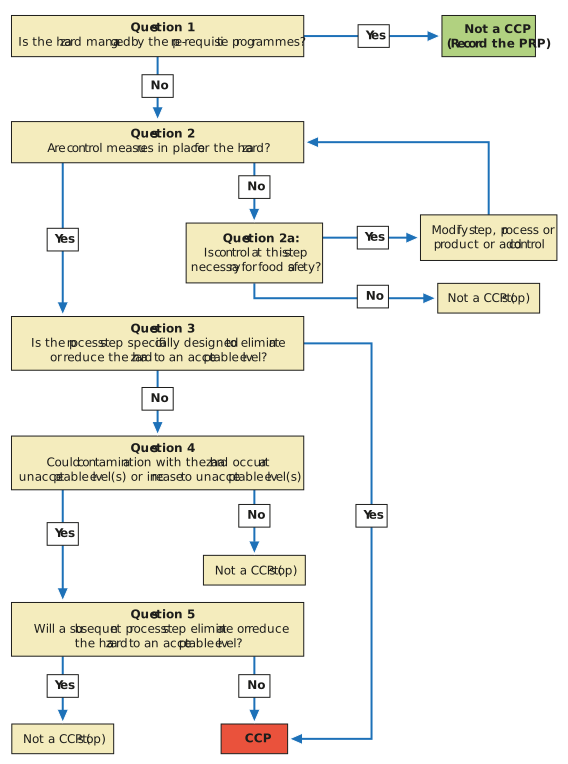
Figure: HACCP decision tree
Stage 6. Establish critical limits for the CCP (HACCP Principle 3)
After we have identified our CCPs, we need to set the critical limits for their control. The critical limit is the maximum and/or minimum level that a process must be controlled at to reduce the occurrence of a hazard to an acceptable level. This does not refer to the amount of the hazardous material (concentration of ATNCs in beer) but the method of control to prevent it. As an example, let us consider a can rinser. On our canning line the rinser is the last opportunity to remove a foreign body from cans before filling. Tests on the rinser with various foreign bodies have shown that there is insufficient pressure in the rinser jet to shift the foreign body at less than 1.5 bar and that at above 3 bar the can could be damaged. The critical limit for the CCP of can rinsing is therefore a minimum of 1.5 bar and a maximum of 2.9 bar.
A critical limit must be measurable, observable, and able to be monitored in real time.
You cannot, for example, use a plate count for Salmonella on an alcohol-free beer as a CCP.
Critical limits can be determined experimentally, by the use of legislation or on the advice of industry bodies or experts. Once determined, you need to validate them by checking that they do indeed effectively manage the hazard. Data from your validation needs to be recorded in your HACCP document.