
Lesson 2 - Quality Assurance and Quality Management
This lesson looks at the management of quality both generally and in the brewery. It discusses definitions of quality and then explains and compares approaches to quality control and quality assurance. Next, it details the components of a formal quality management system as well as tools used in quality management. Finally, it explains what tools are available for the systematic management of food safety and product integrity, and considers how these apply in the brewing industry.
HACCP Continued
Our pre-requisite programmes comprise a raft of measures. If we follow these, we can then use the tool of HACCP to focus in on a few significant risks. We will now explore HACCP, looking at each stage of the preparation and implementation.
Stage 1. HACCP Preparation: Assemble the HACCP team
The HACCP team should comprise staff from a range of disciplines within the production function. Management support, if not participation, is also essential. The size of the team will depend on the size of your brewery but at least one team member should be qualified in HACCP implementation to at least level 3. Subject-matter experts – from each area of the business to be covered by HACCP – also need to be part of the team. The HACCP team should be led by an expert in hazards associated with the area of study who has experience of HACCP implementation. In a small brewery the HACCP team will often be all the staff with the assistance of a consultant.
Stage 1. HACCP Preparation: Establish management commitment
All levels of management in the company up to CEO need to be aware of the HACCP process. They need to ensure the HACCP team leader has this role as part of their job description. They will also be required to allocate the funds to cover any capital costs required to make technical improvements highlighted in the study.
Stage 1. HACCP Preparation: Develop employee awareness of HACCP
To facilitate the implementation and operation of HACCP it is important to ensure staff of all levels understand the aims and requirements of HACCP. In most breweries, awareness is developed through HACCP training.
Stage 1. HACCP Preparation: Define the scope of the HACCP system
In this step we set the boundaries for the HACCP system. The scope views the system from a product and customer perspective and will include the following:
-
Name and description of the products included
-
The target customer for the products
-
The intended use of the product by the customer
-
The process for manufacturing the product
-
The hazards considered
-
Control of the identified hazards by PRPs
Stage 2. Prepare a process flow diagram
We prepare the process flow diagram to set out the activities in the production process. The diagram allows the HACCP team to see the point where hazards can be introduced into the product. The flow diagram should show all the activities where a change is made to the product by processing, addition of ingredients, movement, or packaging. For highly complex products and processes we split the process up into subprocesses to make it more manageable; you should never simplify a process in a diagram. The figure below shows a typical flow diagram for brewery processes.
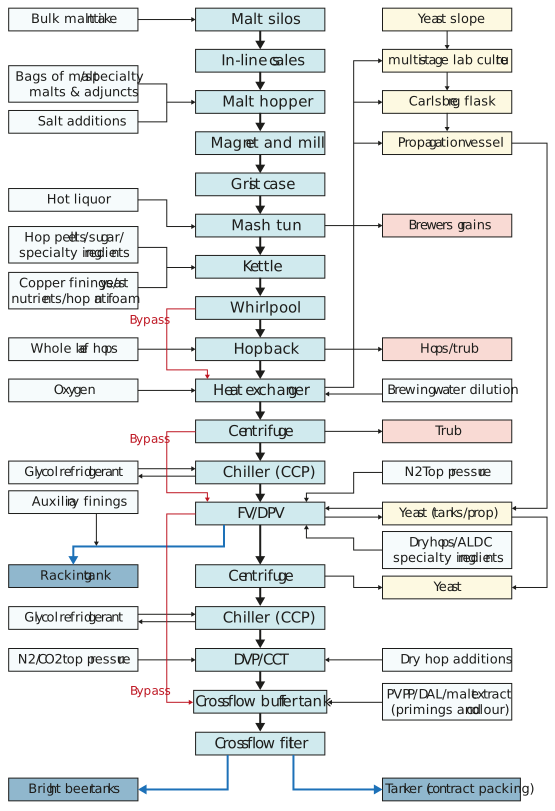
Figure: Process flow diagram
Stage 3. Verify the flow diagram
Before we start the hazard analysis we need to doublecheck our process flow diagrams are accurate and all-encompassing. To do this we walk through the process with the diagram and verify each point is correct. It is a good idea to involve the staff who operate the process on a day-to-day basis as they have a more complete understanding of each component of the process.