
Lesson 2 - Quality Assurance and Quality Management
This lesson looks at the management of quality both generally and in the brewery. It discusses definitions of quality and then explains and compares approaches to quality control and quality assurance. Next, it details the components of a formal quality management system as well as tools used in quality management. Finally, it explains what tools are available for the systematic management of food safety and product integrity, and considers how these apply in the brewing industry.
Quality Assurance Tools
The formal QMS (in the form of ISO 9001) is a good way to manage quality, but there are other tools and initiatives available to manage and improve quality. Quality management is an evolving field and new tools and methods are introduced and adopted before being superseded by yet other new approaches.
Six Sigma
When we check individual analytical data against specifications, we also use statistical methods to determine the nature of that data and the significance of any deviation from the specification target. Six Sigma is a quality-improvement methodology which uses statistical analyses to drive quality improvement by reducing variation. The sigma referred to in Six Sigma is the name of the symbol used for the standard deviation (the standard amount of variation in the data from the process) within a normal distribution. The figure below shows a normal distribution with six sigma levels identified.
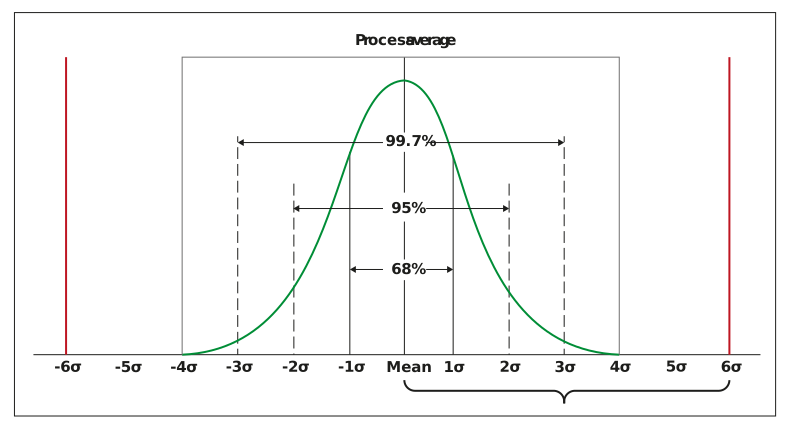
Figure: Six Sigma on normal distribution
The red lines are the upper and lower specification limits so any production beyond these is not of acceptable quality. The percentages shown is the proportion of production that is included in that number of standard deviations. As we move more standard deviations (σ levels) away from the mean, the amount of product included becomes increasingly large. At 6σ this is 99.999998% of all product. Therefore the percentage of product which is out of specification is 100 - 99.999998% or 0.000002%. The greater the variability in a production process, the more variation there will be in the product. The more variation in the product the higher the value of σ and the fewer σ levels will fall between the mean and the specification limits. And of course the greater the proportion of production that will be out of specification!
The table below shows the percentage of non-failures (yield) and the defects per million. You can see that at the level of 6σ the reject rate is 3.4 in one million items produced or defects per million opportunities (DPMO).
Table: DPMO for a range of sigma levels
|
Sigma Level |
DPMO |
Yield |
|
6 |
3.4 |
99.99966% |
|
5 |
230 |
99.977% |
|
4 |
6210 |
99.38% |
|
3 |
66807 |
93.32% |
|
2 |
308583 |
69.15% |
|
1 |
691462 |
30.85% |
You might be thinking, why is the 6σ yield 99.99966% and not 99.999998%? This is because 3.4 defects per million opportunities and this yield were set for 6σ when the system was devised. The reason for this is that a 1.5 sigma shift was introduced to account for long-term variation in a process. So what we call 6σ is actually 4.5σ. True 6σ would give only 2 defects per billion opportunities.
There is confusion among some people and organisations about what 6σ actually is. Some consider it to be plus and minus three sigma from the mean and say that 6σ as we have defined it is actually 12σ.
Any confusion aside, the point of Six Sigma is to try to improve your sigma level and hence the proportion of your products that are in specification.
Six Sigma is used alongside other quality management tools to give a statistical basis to quality improvement. All organisations speak of continuous (or continual) improvement in quality activities but this can be an aspirational concept rather than a defined and measured process. We can use the Six Sigma metric to plan and measure this improvement. The goal is to continually improve the sigma level of quality performance, striving towards six and sometimes beyond. You will see that with each sigma level of improvement defects are reduced. With this reduction we will see reduced costs due to reduced waste and potentially higher sales from an increase in customer satisfaction.
Six Sigma is often associated with Lean Manufacturing. It is important to understand that they are not the same thing. Lean is a means of organising operations where the workplace and business processes are stripped of aspects which are not essential for adding value to the products or the organisation. Lean, in itself, is not a tool for managing quality even though quality improvements can be gained through its implementation.
Six Sigma seeks to involve staff at all levels by giving specific job titles to those with responsibility for achieving its goals. These titles have martial arts names like black and yellow belt, to reflect the person’s status within the system.
Six Sigma is implemented into different business areas or processes as projects. Current sigma levels will be established and then changes will be implemented to increase it. Six Sigma projects use a methodology based on the Deming wheel. Instead of Plan, Do, Check, and Act, the approaches in Six Sigma have the acronyms of DMAIC (pronounced de-may-ick) which is used for improving an existing process and DMADV (pronounced de-mad-vee) used for new processes or products.
DMAIC and DMADV are summarised in the diagrams below.
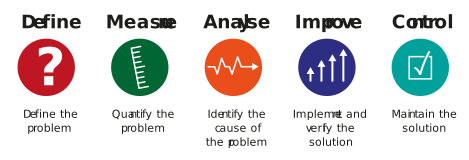
Figure: Summary of DMAIC
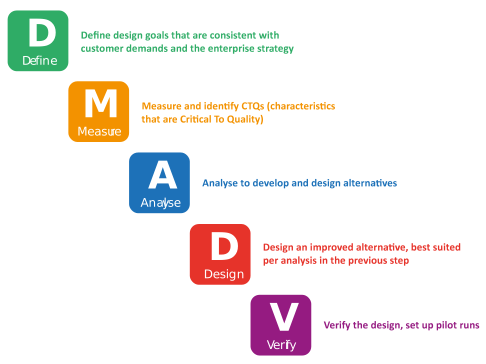
Figure: Summary of DMADV
DMAIC and DMADV, like PDCA, provide a structure for making improvements in quality. The difference is that they tend to be used on a project basis through the Six Sigma hierarchy of belt levels.
We have seen that the Six Sigma approach of DMAIC is related to PDCA. How do you think the five elements in this Six Sigma approach align with the four elements of the PDCA cycle? Give yourself 5-10 minutes to think about this, and then click ’Next’ to continue with this lesson.