
Lesson 2 - Quality Assurance and Quality Management
This lesson looks at the management of quality both generally and in the brewery. It discusses definitions of quality and then explains and compares approaches to quality control and quality assurance. Next, it details the components of a formal quality management system as well as tools used in quality management. Finally, it explains what tools are available for the systematic management of food safety and product integrity, and considers how these apply in the brewing industry.
Quality Management Systems (QMS)
Many breweries have a QMS without realising it. In fact, the QMS actually refers to two things. Let us now look into the what and how of the QMS.
QMS – A system for managing quality
In this meaning, QMS refers to the processes, actions, records, and procedures that a brewery uses to manage the quality of the beer it presents to the customer. In a small microbrewery this will be limited to brewing using accepted ways of working, keeping records for taxation, and using flexible recipes and specifications. As we step up in size of brewery, the system will have increasing complexity and control, and higher degrees of documentation and recordkeeping, until we get to the next meaning.
QMS – A formal documented system for demonstrating compliance with quality best practice
One of the dictionary definitions for a system sums up a formal QMS nicely (if a little generically):
A set of principles or procedures according to which something is done; an organised scheme or method.
The formal QMS is an integrated strategy that ensures the business meets customer requirements by achieving its stated quality goals. Its integration involves departments (functions) working together in a cross functional approach.
We can describe a QMS as a set of internal rules and guidelines, which are aligned to the organisation’s policies, processes, documented procedures, and records. Sometimes, carrying out all of the activities required can feel very administrative.
A formal QMS can be summarised as “Say what you do, then do what you say”.
All quality management systems should provide a framework of what needs to be covered, and what features are required. As a business, you decide the detail and, importantly, stick to what you have decided! The system should be a living process, one that is continually improved and updated.
It is up to each business to decide what their QMS consists of, but if the system is audited they must demonstrate that it is effective (leads to customer satisfaction and continuous improvement) and complies with regulations and standards. The most common approach to QMS implementation is to use the ISO 9000 standards. These standards have been in global use for decades, and are continually updated.
Elements of a formal QMS
A formal QMS will contain at least the following nine elements:
-
Quality objectives: what quality targets the company aims to hit.
-
Quality manual: auditable documentation covering all elements of how the brewery manages quality, comprising policies, structure, procedures, and responsibilities.
-
Organisational structure and responsibilities, setting out roles, titles, and where responsibility lies.
-
Data management: a system for dealing with data relating to quality, such as results from labs or in process checks.
-
Internal management processes, including internal audits.
-
Product quality leading to customer satisfaction (voice of the customer).
-
Continuous improvement including corrective and preventative action providing a means to bring continuous improvement to all elements of how the business operates.
-
Analysis of the key quality attributes.
-
Document control: a system to ensure specifications procedures and records are current and accurate.
The documentary aspect of a QMS is shown in the diagram below:
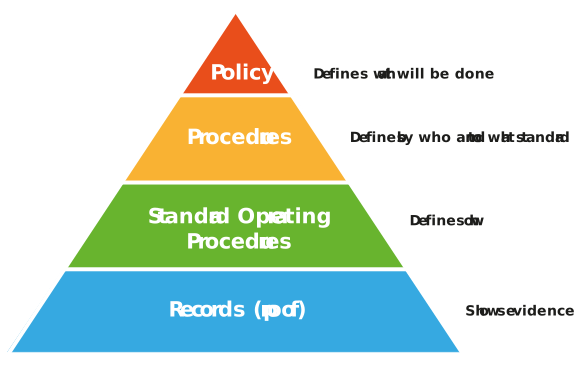
Figure: Structure of documentation in a QMS
As continuous improvement is a key component of a formal QMS the Deming wheel (PDCA) will often be employed. The figure below shows the operation of a QMS with the Deming wheel at the centre.
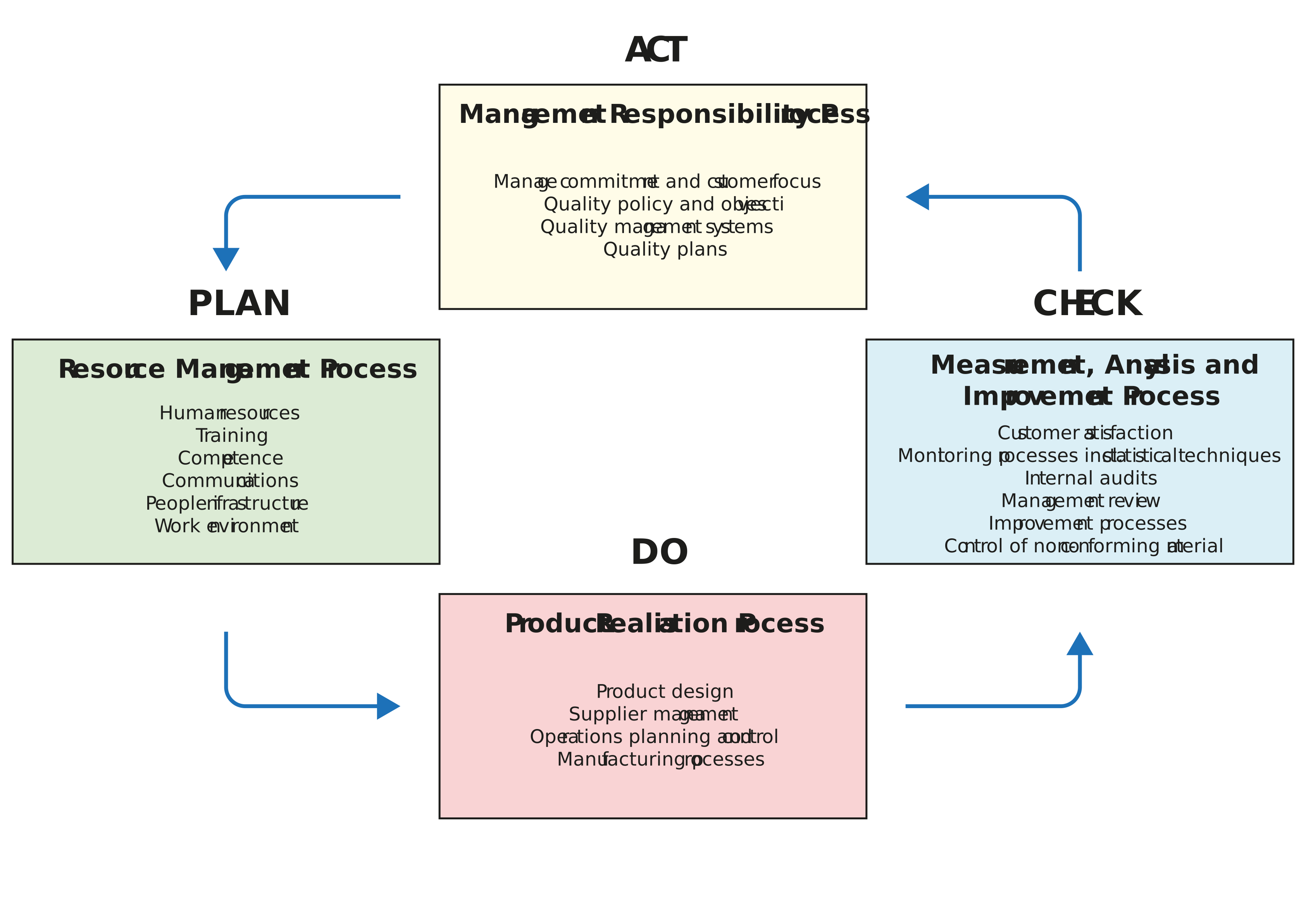
Figure: The PDCA cycle and QMS implementation steps