
Lesson 2 - Quality Assurance and Quality Management
This lesson looks at the management of quality both generally and in the brewery. It discusses definitions of quality and then explains and compares approaches to quality control and quality assurance. Next, it details the components of a formal quality management system as well as tools used in quality management. Finally, it explains what tools are available for the systematic management of food safety and product integrity, and considers how these apply in the brewing industry.
Quality Management
Quality management is made up of the two separate but interrelated approaches of quality control and quality assurance. In quality control we inspect and/or sample the product and take corrective action (quarantine, scrap, or rework) if quality is not adequate. In quality assurance we find ways of preventing the quality of the product becoming inadequate in the first place. In modern quality management the emphasis is entirely on quality assurance, but we still support that approach with an element of quality control. We will now look at the origins and characteristics of each approach.
The history of quality management
We begin with an instructive overview of how the approaches to quality management have evolved.
Did you know the earliest recorded form of quality management is the formation of trade guilds in the middle ages? The guilds controlled the quality produced by their members by setting standards for membership and inspecting members’ work to check standards were being met. Although the guilds exacted some control, the individual craftsmen/women were still responsible for controlling the quality of their own work.
The industrial revolution saw individual control of quality change as labour was reorganised in order to make production more efficient. Forewomen/men were appointed and made responsible for the quality produced by their teams. During the world wars poor quality cost lives so inspectors were introduced into factories to ensure production stopped when faulty items were produced. Some tools, like statistical process control, which were introduced as advances in wartime production are still used today in both quality control and assurance but the approach at the time was exclusively one of quality control.
After the Second World War, the manufacturing industries in Japan needed to be completely rebuilt. Two Americans, W. Edwards Deming and Joseph M. Juran, worked with Japan to make quality integral to the new Japanese systems of production. As a result, Japan became a global leader in manufacturing commercially with the quality of their goods setting them above the competition.
The Japanese approach was to manage quality through the way in which the organisation worked rather than through inspection and control. In the 1970s and ‘80s European and US-based companies were struggling to compete with the quality and price of Japanese products. They identified that the key to Japanese success had been the organisation-wide management approach to quality.
Total Quality Management (TQM) originated in the 1980s (the book Total Quality Control by Armand V Feigenbaum was probably the source of the term) and it represented the West’s adoption of Japanese techniques.
The International Organisation for Standardisation (ISO) defines TQM as a “management approach of an organisation centred on quality, based on the participation of all its members and aiming at long term success through customer satisfaction and benefits to all members of the organisation and society”
The principles of TQM are as follows:
1. Quality can and must be managed.
2. Everyone has a customer and is a supplier.
3. Processes, not people, are the problem.
4. Every employee is responsible for quality.
5. Problems must be prevented, not just fixed.
6. Quality must be measured.
7. Quality improvements must be continuous.
8. The quality standard is defect free.
9. Goals are based on requirements, not negotiated.
10. Life cycle costs, not frontend costs.
11. Management must be involved and lead.
12. Plan and organise for quality improvement.
TQM operates from the top down with a management commitment to quality which leads the whole organisation in understanding and managing quality through meeting the needs of the customer. What made TQM different to earlier approaches to quality management was that it gives quality strategic importance and involves everyone in the organisation and even supply chain partners. Implementation of TQM is a long process and a high percentage of organisations who embraced it early on failed to complete the implementation or found TQM superseded by other approaches. When we look at the Quality Management System (QMS) and ISO 9001 later in this lesson, you will see that many of their elements are similar or identical to the TQM principles above. So, while TQM is a diminished tool today, its principles are still valid and applied in modern quality management.
Quality Control (QC)
Quality control is a system of controlling quality by inspecting a sample and comparing it to a specification. Samples are usually taken from a statistically significant quantity of product. The results of the testing determine if all of the product is fit for sale or for movement on through the production process. It focuses solely on the output of production processes.
In the brewery our laboratories are the principal areas involved with quality control. In modern approaches to quality management, labs tend to be associated with areas of production, rather than being centralised, and are operated by multiskilled staff rather than dedicated QC personnel. In this way quality is owned by everyone, not just the people in white coats! That said, it is still considered to be good practice for the QC department to be independent of the management of the production function in order to maintain objectivity. Also, certain food safety and legal analyses are undertaken exclusively in the central lab.
Try to obtain a copy of your brewery’s monitoring and measuring programme. This will reflect the aspects of the beer that have been identified as important to the customer to be measured against a specification. Read through it, linking the elements to the experience of the customer. If your brewery doesn’t have one, why not develop one on the customer expectation principle?
Quality Assurance (QA)
With quality assurance, we see a broader approach to managing quality than in QC. QA relates to the organisation as a whole, from administration to plant and practice to the checks, tests, and audits used to make sure the required standards are consistently met or exceeded.
There are so many commonalities between QA and TQM some say they are synonymous. Others argue that with its emphasis of the strategic importance of quality, TQM is an evolution of QA.
How do we decide our quality standards?
-
We build in the voice of the consumer so they mirror what our customer wants.
-
They must be quantifiable, measurable, and manageable.
-
They need to ensure we are compliant with legislation and that what we make is safe to consume.
-
The frequency and volume of our checks need to be proportional to the volume produced, the frequency of production, and the level of risk from the element being checked. (For example, the relative risk to quality means that the frequency of testing CIP final rinse water pH will be far greater than for checking the contents of the destoner hopper.)
QC is about measurement and inspection. QA is about demonstrating confidence in processes and products, as well as driving the improvement of systems.
We structure the quality assurance of a product into the following steps:
1. Define the requirements and responsibilities relating to the quality of individual activities, processes, and materials.
 2. Define the desired and required properties and parameters of the product.
 3. Define all materials, technologies, packaging, and storage conditions, and the number and qualifications of personnel.

4. Analyse possible sources of faults and factors affecting quality.

5. Define the quality assurance actions: information, education, training, motivation, parameters of investigations, methods of analysis, and sampling documentation.

6. Define responsibilities for certain quality assurance actions.
These steps show us a process of: defining what needs to be managed; quantifying it; assembling the capability to measure and manage it; and then allocating responsibility for that measurement and management. This is the essence of QA. Although the steps above suggests a linear approach, QA is actually based on an iterative cycle of planning, implementation, review, and action, or put more simply Plan – Do – Check – Act (PDCA). This cycle was first championed by W. Edwards Deming and is also known as the Deming wheel. It is designed to bring continuous quality improvement or Kaizen (Japanese for improvement). The diagram below shows the relationship between PDCA and continuous improvement.
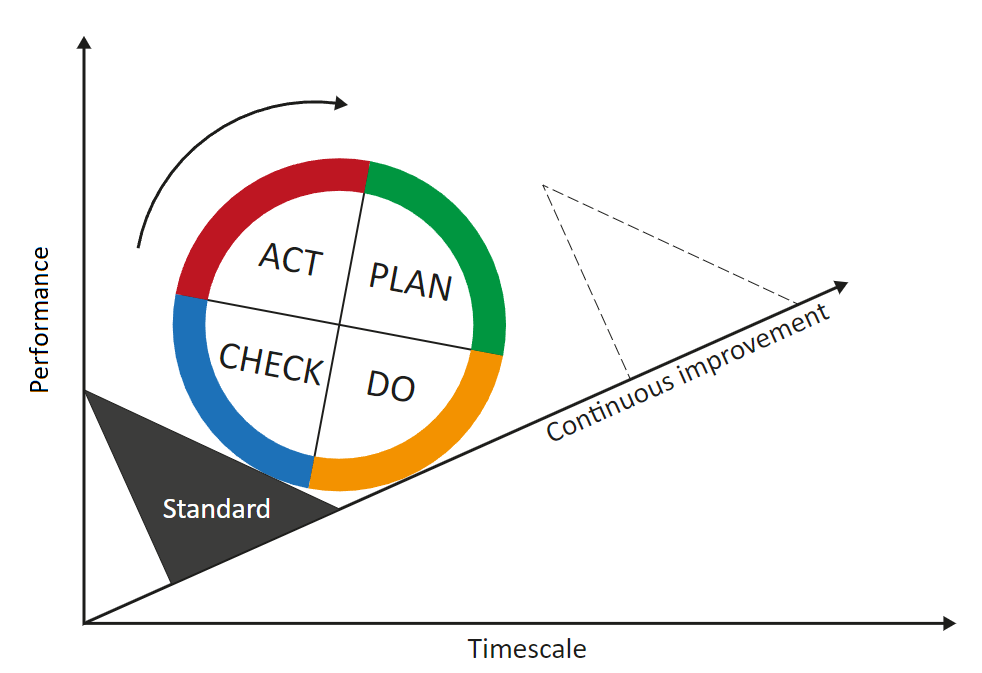
Figure: The Deming wheel and continuous improvement
Despite the similarities in their names and ultimate objective, we can clearly see the differences between the approaches of QA and QC. Some of the key contrasts are described in the table below.
Table: The contrasts between QA and QC
|
QA |
QC |
|
Proactive |
Reactive |
|
Everyone responsible |
QC department responsible |
|
Process orientated |
Product orientated |
|
Part of new product development |
Used to test products after development |
|
Prevents problems |
Identifies and removes problems |
This has given us a sound understanding of the basis of QA and QC. Before we move onto the next section we will briefly examine how they interrelate. In most modern breweries QA and QC exist as components in the system used to manage quality. Their relationship is illustrated in the diagram below.
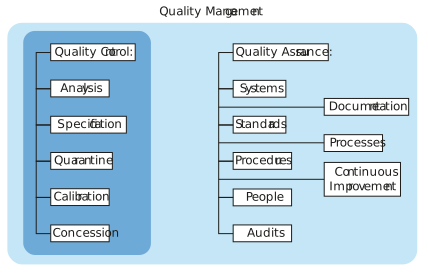
Figure: The interrelation of QA and QC in quality management
In the ideal brewery, using 100% QA would mean that every potential problem with beer would be solved by the management of quality and there would be no need for QC sampling before release. The ideal brewery will probably never exist, so the complementary approaches of QA and QC are essential for great beer and happy customers.
Now that we have learned about how QA and QC manage quality in their own spheres and together as part of quality management, we can build on this knowledge and discover quality management systems.