
Lesson 6 - Beer Flavour and Stability
In this lesson we will discuss beer flavour and beer flavour stability. This will include the effects raw material has on beer flavour, followed by a discussion on common taints, their flavours and consumer reaction. We will examine the flavour changes that occur during beer storage: focussing on oxidation reactions, the species of oxygen involved, and how we can utilise antioxidants to protect against aged beer flavour change. Finally, we will summarise the selection of raw materials and process optimisations available to improve beer flavour stability.
Photochemical degradation of Iso-α-acids
The well-known light catalysed degradation of iso-α-acids results in skunky or lightstruck off-flavours in beer.
The vitamin riboflavin (vitamin B2) is excited by visible light and will extract an electron from the side-chain of the iso-α-acids, leading to a series of reactions that cleave off the side-chain and form the 2-methyl-2-butene radical.
After the reaction with a sulphur-containing thiol, 3-methyl-2-butene-1-thiol (MBT) is formed. This molecule is extremely flavour-active, producing the lightstruck flavour at concentrations of 7 ng/L. This reaction is very rapid in sunlight but can also happen over time in areas illuminated by artificial lights.
Brewers protect the beer in the bottle by using amber glass, which serves to block much of the problematic shorter wavelength visible light. Green glass is less protective and clear (flint) glass will give lightstruck aroma if unmodified hops are used.
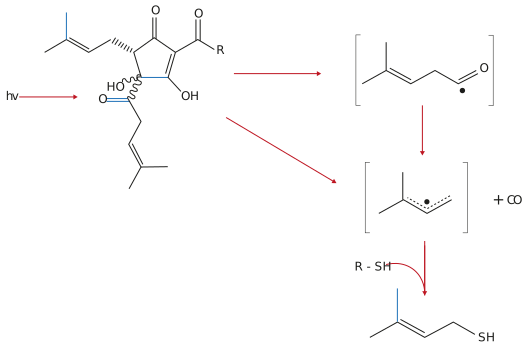
Figure: Formation of MBT by photochemical degradation of iso-α-acids