
Lesson 6 - Beer Flavour and Stability
In this lesson we will discuss beer flavour and beer flavour stability. This will include the effects raw material has on beer flavour, followed by a discussion on common taints, their flavours and consumer reaction. We will examine the flavour changes that occur during beer storage: focussing on oxidation reactions, the species of oxygen involved, and how we can utilise antioxidants to protect against aged beer flavour change. Finally, we will summarise the selection of raw materials and process optimisations available to improve beer flavour stability.
Primary Beer Flavours
Primary beer flavours are those present at levels at least twice their flavour threshold in beer. These are ethanol, hop bittering compounds and carbon dioxide.
In speciality beers, we can add:
-
Hop aroma compounds
-
Maillard reaction caramel flavours such as:
- Furaneol
- Maltol
- Isomaltol
-
Short chain acids
-
Esters
-
Alcohols
Secondary flavours make up the bulk of beer flavour and are defined as having levels from 0.5-2 times the flavour threshold. These include the yeast-derived volatile flavours from esters and higher alcohols, and the medium chain fatty acids. The flavour unit presented is simply the concentration present divided by its flavour threshold.
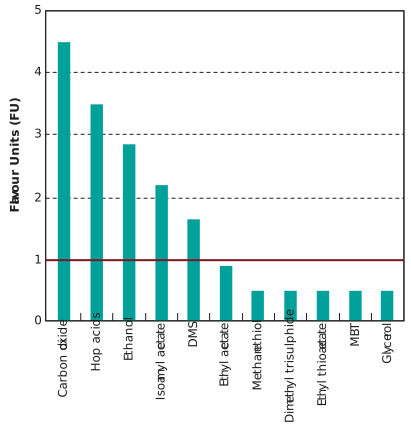
Figure: Flavour-active compounds in a European lager. 1 FU = concentration at taste threshold
A Flavour Unit (FU) = Concentration of flavour compound/flavour threshold