
Lesson 6 - Beer Flavour and Stability
In this lesson we will discuss beer flavour and beer flavour stability. This will include the effects raw material has on beer flavour, followed by a discussion on common taints, their flavours and consumer reaction. We will examine the flavour changes that occur during beer storage: focussing on oxidation reactions, the species of oxygen involved, and how we can utilise antioxidants to protect against aged beer flavour change. Finally, we will summarise the selection of raw materials and process optimisations available to improve beer flavour stability.
Hops
The isomerised alpha acids provide bitterness to the beer. As a beverage, beer is unique in its use of hops; most contain iso-alpha acids above their taste threshold. Highly hopped beers such as IPAs can taste very bitter. Depending on beer style and processing conditions, hop oils can produce strong fruity and floral aromas.
Bitter compounds
Much of the perceived bitterness in beer is from the three isomerised alpha acids (iso-α-acids) in both their cis and trans forms:
-
Iso-humulone
-
Iso-cohumulone
-
Iso-adhumulone
These six iso-α-acids contribute different perceptions to the of bitterness of beer. Cis isomers are more bitter than the trans forms, and isocohumulones are less bitter than isohumulones; however, some consider isocohumulones to contribute more of a harsh, unpleasant bitterness. This belief is based on a flawed study and the number of people who believe it is becoming increasing small.
The brewer cannot change this through processing; it is a function of the hop variety they select for use.
Overall bitterness is derived not only from the iso-α-acids. The oxidised forms of the beta acids (β-acids), interestingly named hulupones, are in fact 10% more bitter than the corresponding iso-α-acids although significantly less soluble.
Something of particular interest to brewers seeking hop aroma on their beers is that contrary to popular belief, dry hopping will add bitterness to beer. The α-acid oxidation products, known as the humulinones, are themselves bitter and soluble in beer, contributing 66% of the bitterness of the corresponding iso-α-acid. The makers of such beers need to factor this into their recipes.
As you have learnt, we measure bitterness with the International Bitterness Unit (IBU). To refresh your memory, this is defined as:
-
A spectrophotometric (light absorption) reading at 275 nm of a 10 ml acidified beer sample extracted into 20 ml iso-octane, multiplied by 50.
However, when using isomerised hop products post-fermentation, this reading is multiplied by 70, to reflect the higher bittering potential of these products. This is arbitrary and is meant to reflect that 1 IBU = 1 mg/L of iso-alpha acid. That too is an approximate benchmark for bitterness, as we have already discussed, the different bittering intensity of the iso-α-acids. In addition, this measurement will measure other bittering compounds besides the iso-α-acids.
As a result, the HPLC instrument is used to measure the sum of the three iso-α-acids and report this as mg/L iso-acids. However, this will not measure the oxidised α-acids. Case in point – bitterness is hard to quantify!
Modified hop products also contribute to bitterness. The reduced tetrahydro-iso-α-acid is more bitter than the corresponding iso-α-acids. This is assumed to be because of its increased hydrophobicity (i.e. ‘water hating’ or insoluble in water). The less hydrophobic rhohydro-iso-α-acid is less bitter, supporting this theory.
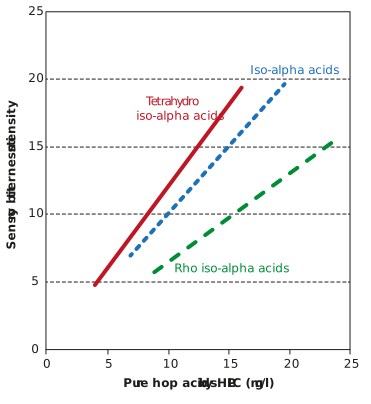
Figure: Relative bitterness of hop products
Aroma compounds
The hop oils constitute only 0.5-3% of the hop cone mass but contribute a big part to beer flavour when added towards the end of boiling. This happens either in the whirlpool hot wort stand, during fermentation or in maturation. The detailed chemistry of the hop oils was dealt with in the Diploma in Brewing (Module 1).
In summary, the hop oils are 50-80% hydrocarbons, and of these myrcene, which is a monoterpene (C10), makes up the majority and contributes the typical fresh hop aroma. The sesquiterpenes (C15) include humulene, caryophyllene and farnesene, a characteristic of Saaz hops.
Currently, there is much interest being paid to the more soluble oxygenated hydrocarbons, which persist in late and dry hopped beer and make up 20-50% of the oil’s compounds. This group is diverse and includes limonene, linalool, nerol, terpineol, citronellol, and geraniol. The oxygenated hydrocarbons produce aromatic, fruity flavours associated with dry hopping.
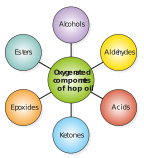
Figure: Groups of compounds found in the oxygenated fraction in hop oil
Table: Oxygenated hop compounds and their flavours
|
Compound |
Category |
Aroma |
|
Linalool |
Alcohol |
Floral, orange |
|
Citral |
Aldehyde |
Sweet citrus, lemon |
|
Geraniol |
Alcohol |
Floral, sweet, rose |
|
Nerol |
Alcohol |
Rose, citrus |
|
Terpineol |
Alcohol |
Woody |
|
Ethyl-2-methylbutyrate |
Ester |
Fruity |
|
3-methylbutyric acid |
Acid |
Cheesy |
|
1-hexanal |
Aldehyde |
Green, grassy |
|
Humulene epoxide II |
Epoxide |
Spicy, herbal |
|
2-Heptanone |
Ketone |
Fruity |
The oxygenated compounds are also involved with bio-transformations which produce other aromatic compounds. This happens with yeast activity, especially during active fermentation. Several of these volatile compounds, however, are lost with the CO2 produced. To maximise the flavour from dry hopping, many brewers employ the practice of one dry hop addition during active fermentation, followed by subsequent additions post-completion of active fermentation.
Hop oil chemistry is complex, with over 450 compounds currently identified. In the context of beer flavour, sulphur-containing compounds, which constitute < 1% of the total oil, are responsible for many of the tropical fruit hop aromas found in the American hop-forward beer styles. Under stressful hop growing conditions these can occur as ‘drainy’ unpleasant sulphur on the raw hop, but through bio-transformations involving yeast, they form pleasant aromatic fruit aromas.
The fruity sulphur-containing compounds (thiols) researched so far are:
|
4MMP |
4-mercapto-4-methyl-2-pentanone |
Catty or blackcurrant aroma |
|
3MH |
3-mercaptohexanol |
Rhubarb aroma |
|
3MHA |
3-mercaptohexanol acetate |
Grapefruit aroma |
|
3M4MP |
3-mercapto-4-methylpentanol |
Grapefruit aroma |
The hop aromas in beer are largely dependent on addition practices, as well as hop variety, growing and storage conditions. Hop merchants are now starting to list some of these oils on their analyses as brewers seek out hops able to impart intense aromas.