
Lesson 6 - Beer Flavour and Stability
In this lesson we will discuss beer flavour and beer flavour stability. This will include the effects raw material has on beer flavour, followed by a discussion on common taints, their flavours and consumer reaction. We will examine the flavour changes that occur during beer storage: focussing on oxidation reactions, the species of oxygen involved, and how we can utilise antioxidants to protect against aged beer flavour change. Finally, we will summarise the selection of raw materials and process optimisations available to improve beer flavour stability.
Flavour Changes During Beer Storage
Due to continued chemical reactions in beer after packaging, the flavour of beer does not remain constant and in most cases will become less acceptable to consumers over time. Dalgliesh published the often reproduced diagrammatic plot of flavour change over time, in 1977. Whilst the work was done on ales, some of the changes are also applicable to lagers.
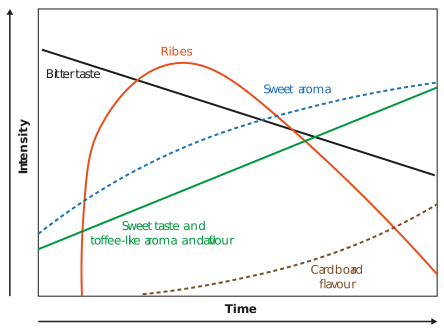
Figure: Flavour changes of packaged beer over time
It is worth stating that aged beer changes do not form compounds that can be harmful to health; however, consumers expect the beer to taste the same until it reaches it sell by date.
While the flavour changes mentioned above are somewhat generic and perhaps simplistic, they do indicate some general changes occurring in beer. These changes are influenced by many things, including the beer style, storage temperature and intrinsic content. We will expand on some of these specific changes below but let us first try to summarise the factors involved.
As beer is stored, two main changes take place:
-
A decrease in desirable flavours
-
An increase in undesirable flavours.
The well-known loss or ‘scalping’ of hop oil hydrocarbons and oxygenated hydrocarbons into crown liners, is one of the former effects. An increase in off-flavours can result from the formation of new flavour active compounds, or release of a pre-formed flavour compounds.
-
Intrinsic content describes the composition of the beer itself
-
Extrinsic factors refer to conditions to which the packaged beer is subjected
As brewers and packers, we can influence the intrinsics of beer. Modern packaging lines will ensure in-package dissolved oxygen levels of < 50 µg/L, which can be reduced further by oxygen-scavenging crown liners.
The extrinsic factors are more difficult to control. Some brewers invest in influencing external factors, for example, distributing their products in a cold chain, and managing beer age and storage conditions in the retail outlets.
Temperature, along with oxygen, is the most important factor involved in flavour changes. The warmer the beer, the more rapidly it deteriorates. The influence of temperature is described by the Arrhenius equation, which predicts a doubling to trebling of a chemical reaction with a 10 ºC rise.
Of the intrinsic factors, the most widely studied is oxygen.