
Lesson 6 - Beer Flavour and Stability
In this lesson we will discuss beer flavour and beer flavour stability. This will include the effects raw material has on beer flavour, followed by a discussion on common taints, their flavours and consumer reaction. We will examine the flavour changes that occur during beer storage: focussing on oxidation reactions, the species of oxygen involved, and how we can utilise antioxidants to protect against aged beer flavour change. Finally, we will summarise the selection of raw materials and process optimisations available to improve beer flavour stability.
Beer Flavour Description
In the 1970s, Morten Meilgaard of the Stroh Brewing Company, and Charles Dalgliesh and John Clapperton (both from the then Brewing Industry Research Foundation), produced a ground-breaking paper on beer flavour terminology. This was a collaboration between working groups of the European Brewery Convention (EBC), the American Society of Brewing Chemists (ASBC) and the Master Brewers Association of the Americas (MBAA).
The beer flavour wheel they developed enabled naming and defining flavour notes in beer; this then enabled a standard for communication within the global beer industry. The system comprised of 44 tier-one terms with an additional 78 tier-two terms, allowing identification of individual flavours. While there have been some changes over the past 40 years, the wheel remains largely unchanged.
The original paper can be read here:
https://onlinelibrary.wiley.com/doi/abs/10.1002/j.2050-0416.1979.tb06826.x
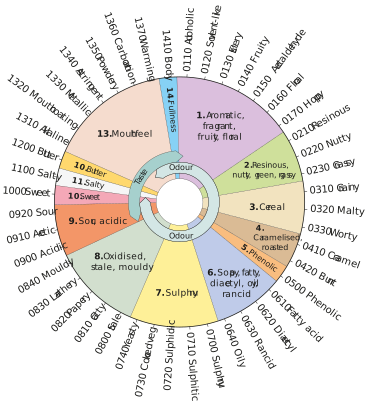
Figure: Updated flavour wheel showing tier-one and tier-two flavours grouped into 14 categories