
Lesson 6 - Beer Flavour and Stability
In this lesson we will discuss beer flavour and beer flavour stability. This will include the effects raw material has on beer flavour, followed by a discussion on common taints, their flavours and consumer reaction. We will examine the flavour changes that occur during beer storage: focussing on oxidation reactions, the species of oxygen involved, and how we can utilise antioxidants to protect against aged beer flavour change. Finally, we will summarise the selection of raw materials and process optimisations available to improve beer flavour stability.
Preface
The previous lessons covered the visual appeal of beer, namely foam and clarity. In this lesson, we move to the intrinsic appeal of beer, in other words, it’s all about the taste!
We will cover the contribution of raw materials to flavours, excluding those produced by yeast, which are covered in the Fermentation unit (lesson 4). We then look at flavour defects caused by taints and the ageing of beer. Lastly, we explore the treatments aimed at prolonging the freshness of beer.
Beer flavour is incredibly complex, with hundreds of compounds contributing significantly towards it; it would be an impossible task to measure all of these. Flavour evaluation of beer relies on trained taste panels to describe the aromas and tastes of the finished product. A competent trained taster will be able to recognise and name around 40 individual flavour compounds, which is considered sufficient to describe a bulk produced brand.
Before we discuss the major flavours that make up beer, let us backtrack a little to understand how we, as humans, perceive flavour.
Flavour
Flavour is the sensory impression of food or other substances, and is determined primarily by the chemical senses of taste and smell. The trigeminal nerve plays an active role too. This is the fifth cranial nerve, and extends into both the nasal and maxillary and mandibular areas of the mouth (top and bottom). Its role is complex, but we know that it senses pain as well as and hot and cold. This is fundamentally significant for beer, which we discuss later in this lesson.
Of these three senses, the olfactory sense (smell) is the most important. Odour is actually perceived in two ways: orthonasal and retronasal. These are both important in formal beer assessment. The differences are shown in the figure below. The retronasal sense of taste is intimately linked to that of smell.
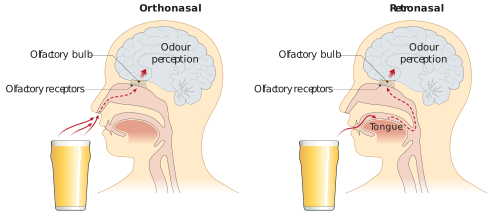
Figure: Odour perception
Taste in the oral cavity is primarily concentrated on the tongue, although the entire mouth contains free nerve endings which perceive pungency and astringency.
The tongue contains receptors involved with the detection of the five primary tastes: sweet, sour, salty, bitter and umami (or savoury). There are different receptors or taste buds on different areas of the tongue but contrary to popular belief, these are not explicitly for specific tastes.