
Lesson 6 - Process Aids and Additions
This lesson discusses the function of process aids and how they improve colloidal stability. It also explores filter aids, post-fermentation additions, and the use of deaerated water as tools to enable a brewer to meet their final pack beer quality specifications.
Carbonation
CO2 solubility is measured in volumes of CO2 per volume of beer at standard temperature and pressure (SPT).
Typically, packaged product contains 2.2-2.8 v/v of CO2 (some products will be higher, e.g. bottle-conditioned beers; some will be lower, e.g. ales). However, beer usually only contains 1.2-1.7 v/v by the end of fermentation.
To convert volumes of CO2 (v/v) into grams/litre (g/L), use the following equation for a beer of 2.55 v/v CO2 (L/L) :
1 mole CO2 at STP occupies 22.4 L
Thus 44g/22.4 L or 0.509 L/g
v/v / 0.509 = g/L
2.55 / 0.509 = 5.01 g/L
As a quick conversion g/L is approximately double v/v.
The brewer must add CO2 to the beer in order to bring it into specification. We can achieve this by dosing it in a controlled manner, using various means such as injecting CO2 in-line via a venturi, involving a series of static mixers. Or, we could gently bubble gas into a tank of beer using a carbonation stone (we will discuss this further later on).
CO2 is either recovered from fermentation and then purified for re-use in the brewery, or we can source it externally from plastic manufacturing or other industries. CO2 is kept in liquid form in the brewery, under a large pressure, and at a cold temperature to retain its liquid state. Typical conditions are -35°C to -15°C at a pressure of 12-25 bar.
Let us look at carbon dioxide a bit more closely and explore some of the physics surrounding it!
The amount of CO2 in a solution depends on Henry’s Law. This law states that the quantity of gas in a liquid is proportional to that of the headspace. The concentration of gas in the beer can be increased by increasing the head pressure of gas. Henry's Law can be expressed as a simple equation (note, this will be covered in more detail in Diploma in Brewing 3):
Concentration of gas in liquid = K × P gas
Concentration of a gas in liquid = K (the constant) × partial pressure of that gas in the gas phase. The constant, K, is a unique characteristic of every gas.
By using the principles of Henrys Law, we can design a system that enables us to dissolve gases in liquids.
The gas is introduced into the beer by either dropping the pressure of the liquid using a venturi carbonator, or by raising the pressure of the gas. The gas is then dissolved into the beer by increasing the gas’ surface area as much as possible, e.g. by creating small bubbles via a sintered metal carbonator.
Temperature also affects CO2 solubility; the lower the temperature of the beer, the more that the CO2 solubility increases. Creating dynamic conditions with good mixing helps facilitate CO2 dissolution into the beer. This includes using static conditions, such as applying top pressure on the beer vessel. If the pressure of the CO2 is higher than the levels in the beer, the CO2 will dissolve into the beer in order to reach an equilibrium. However, dissolution will be slow and achieve uneven results, as there will be inadequate mixing.
So, to have an effective carbonation system, we need to increase solubility by having:
-
Low temperatures
-
High pressure
-
The means with which to finely disperse the CO2 as tiny bubbles
The following are examples of well-known methods that we can use to carbonate beer:
1. Venturi Carbonator - The venturi is made, for example, from a section of 100 mm diameter pipe that has been ‘flattened’. This creates a section with a reduced flow area. As beer passes through the venturi, the velocity increases and there is a corresponding pressure decrease. CO2 is injected into the beer at the low-pressure zone. Absorption is aided by the high degree of turbulence in this zone and by the pressure increase that occurs in the diffuser section. In this section, the area increases. This reduces velocity and increases pressure.
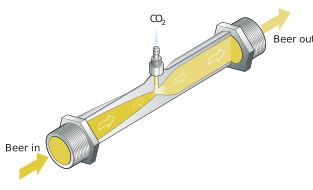
Figure: Section through a Venturi carbonator
2. Sintered diffusers - Sintering is a process where metal or ceramic particles are pressed into a shape then heated to just below their fusion point. Partial fusion takes place to create a mechanically strong yet porous material. The sintered material is made into a cylindrical shape, often referred to as a ‘candle’ or ‘stone’. By passing CO2 through the candle immersed in a liquid, this forms many fine bubbles. Fine bubbles are absorbed readily by the liquid. A ‘carbonation stone’ is an example of this; the CO2 is pushed through pores of only 0.5 µm!
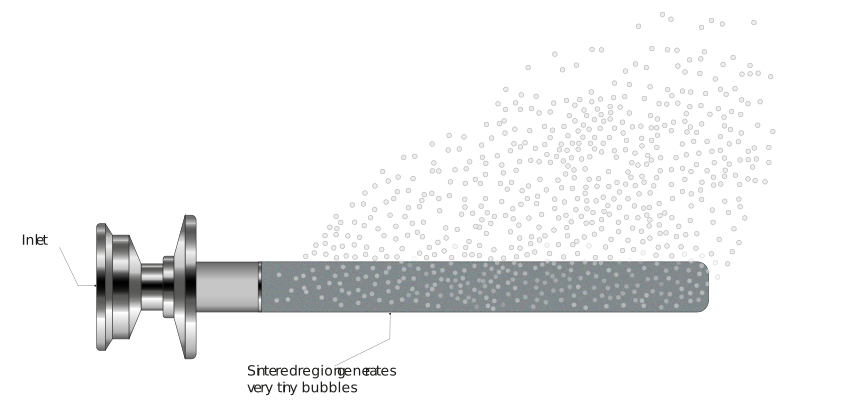
Figure: Carbonation stone
This creates tiny bubbles and promotes the dissolution of CO2 into the beer. The following video shows this operation:
3. Nozzles - Many breweries still prefer the simplicity of an injection nozzle. The gas is forced through the fine hole at the end of a nozzle, which disperses fine bubbles into the liquid. Nozzles are more easily cleaned than sintered diffusers.Some carbonation equipment is combined with dilution, creating what is often termed a ‘carbo blender’.
The carbo blender skid is equipped with several specifically designed vortex injectors that inject the gas as fine bubbles into the liquid stream. These nozzles ensure that the carbon dioxide dissolves homogenously in a very short time. At the system’s outlet, the CO2 content is permanently measured with a sensor. Based on this accurate in-line measurement, the gas flow is adjusted instantly and fully automatically. Alternatively, we could finely disperse and dissolve the CO2 bubbles using a series of static mixers.
The method for adding deaerated water for product dilution uses the same principles of pre and post % ABV measurement; this controls the deaerated water addition rate. As shown in the figure below, the beer pipe snakes through the carbo blender system to help mix the deaerated water and dissolved gas, and achieve a homogenous liquid. Before any liquid is introduced into the carbo blender, it must be cleaned, sterilised, and flushed with deaerated water to displace any oxygen that would otherwise risk oxidising the beer and create staling flavours.
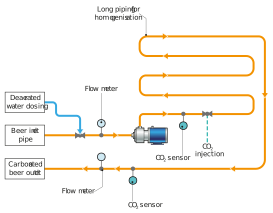
Figure: Carbo blender – skid-mounted
We could also use these carbonation methods for nitrogenation.