
Lesson 6 - Process Aids and Additions
This lesson discusses the function of process aids and how they improve colloidal stability. It also explores filter aids, post-fermentation additions, and the use of deaerated water as tools to enable a brewer to meet their final pack beer quality specifications.
Deaerated Water
Deaerated water is used in many parts of the brewing process post-fermentation. It is used to push product through the product lines. It is also used to mix any flavours, process aids, or other additions. Furthermore, we can use it to dilute the beer in high gravity brewing.
The original gravity of a beer determines its final alcohol level. High gravity brewing is where we brew wort at a higher gravity than what is required to produce the final beer.
A normal starting gravity for a wort is generally between 10-13°P. This will result in a beer at 4-6% alcohol by volume (ABV). A high gravity wort is typically between 14-17°P, which will result in a 6-8% ABV beer. Original gravities can exceed this, although it is uncommon.
In order for the beer to be in specification for packaging, we must dilute the high gravity beer with water. However, standard brewing product is not ideal, as it is uncarbonated and high in dissolved oxygen (DO). Although the diluted beer can be carbonated, the high levels of dissolved oxygen can lead to flavour instability of the beer.
Principles of deaerated water plants
There are a number of methods that we can use to strip oxygen from water. We will look at three methodologies:
Gas stripping Columns
- Cold (ambient) stripping technology: Stripping of DO is performed by passing ambient brewing water through a packed bed in a vertical stripping column, with a counter-current flow of brewery CO2 (DO < 10 μg/l) as the stripping gas.
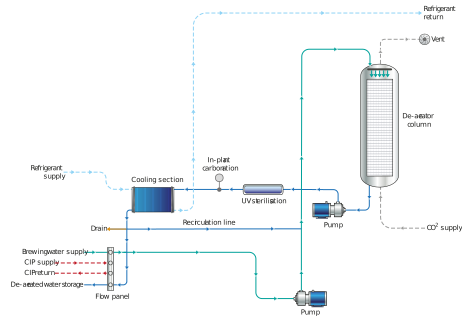
Figure: Process flow – cold (ambient) stripping D-Plant
- Hot stripping technology: Similar to cold stripping, but incoming brewing water is heated, typically to 72°C using recovered heat from the exiting water and then using steam, before passing through the stripping column. The higher temperature speeds up the rate of oxygen removal, allowing for a shorter column to achieve the required reduction in DO levels.
Hollow-fibre membrane deaeration technology: Water is passed through a chamber containing a high number of small diameter tubes, which are manufactured from a gas porous, hydrophobic plastic. Gas passes through the small tubes counter-current to the water. Gases such as oxygen, CO2, N2, and even hydrogen pass from the water into the small tubes via microscopic pores. This ‘state of the art’ technology is highly effective.
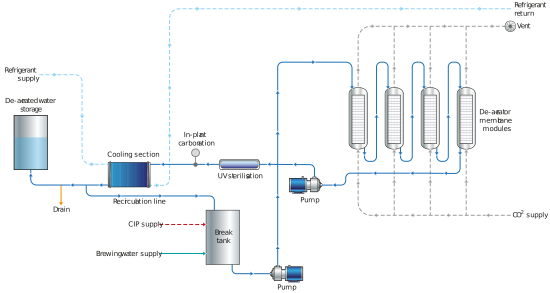
Hollow-fibre membrane deaeration technology
Vacuum deaeration: Water is sprayed into a vacuum chamber. The level of vacuum is adjusted based on the required oxygen content, temperature, and product characteristics. The deaerated water falls to the bottom of the chamber and is then pumped away.
Dilution water does not always need to be carbonated, as the beer can be carbonated post-dilution. However, carbonating the dilution water does help to reduce the dissolved oxygen. It also reduces the amount of carbonation required post-dilution.
The best time to dilute the beer is after the filters. If the beer is being filtered, this maximises the capacity benefits. If not, then dilution could happen en route (to vessel or the packaging line), in the maturation vessel, or in the final product tank.
This means that the dilution water will need to adhere to some strict specifications so that it does not negatively affect beer quality.
Dilution water should ideally:
-
Be free from colour and flavour taints
-
Not affect the beer pH
-
Either be demineralised or have the same mineral profile as the beer. This is because certain minerals can affect the flavour of the beer, both positively and negatively
-
Be filtered to ensure that it is free of particles
-
Be sterile (using filters, UV light, or chlorine dioxide)
-
Have a dissolved oxygen of less than the final beer’s dissolved oxygen specification, but typically less than 10 µg/L
-
Have a temperature below 4°C to prevent the beer warming up and making the CO2 less soluble
-
Be carbonated to the same level as the beer (if possible)
Ideally, the dilution water should be mixed in-line with the beer on the way to the final product tank. This will help to ensure that the dilution water and the beer are well-mixed. If diluting in the vessel, the brewer must ensure that the vessel contents are agitated and well-mixed to prevent layering in the tank. Layering would result in a layer of undiluted beer and a layer of overly diluted beer, which will both be out of specification as the beer is packaged.
We can calculate the amount of dilution water required using the following formula:
volume (post-dilution) = [alcohol (pre-dilution) x volume (pre-dilution)] / target alcohol
dilution water = volume (post-dilution) – volume (pre-dilution)
For example:
Your beer has a total volume of 5 hL and an alcohol of 6.3% v/v. Your final beer alcohol target is 5.25%. What volume of dilution water do you require to achieve this alcohol target?
volume (post-dilution) = [alcohol (pre-dilution) x Volume (pre-dilution)] / target alcohol
volume (post-dilution) = (6.3% x 5 hL) / 5.25%
volume (post-dilution) = 6 hL
Therefore 6 hL – 5 hL = 1 hL of dilution water required
As mentioned earlier, the deaerated water is often carbonated to achieve a similar carbonation level in the beer. However, in most cases, the beer needs to be further carbonated to achieve the specified target CO2 in package.