
Lesson 6 - Process Aids and Additions
This lesson discusses the function of process aids and how they improve colloidal stability. It also explores filter aids, post-fermentation additions, and the use of deaerated water as tools to enable a brewer to meet their final pack beer quality specifications.
Non-Biological Haze
There are two types of non-biological haze, namely chill haze and permanent haze.
When beer is chilled to sub-zero temperatures during maturation, a haze develops. If the beer warms up en route to the filter, the haze dissolves only to reform in the bottle in the consumer’s fridge. This haze is called chill haze and is defined as a haze that appears in a beer upon chilling, and re-dissolves on warming to 20°C.
Permanent haze forms as a result of repeated cooling and warming cycles. Once formed, it will not re-dissolve. Permanent haze is defined as a haze that is stable at 20°C.
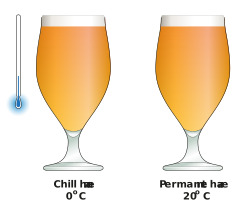
Figure: Chill haze and permanent haze
The most common non-biological chill hazes form in beer from the loose bonding of proteins and polyphenols. Proteins and polyphenols come from the malted barley, although hops are also a source of polyphenols. Even a small amount of protein on its own is sufficient to cause hazy beer. The polyphenols have two ends that can bind to protein. The proteins contain a fixed number of proline-rich regions that act as polyphenol binding sites, as shown in the figure below.
Malt storage proteins called hordeins are the source of these haze proteins; they are rich in the amino acid proline. Proline is able to bond with polyphenols using hydrogen bonds and hydrophobic interaction, which is the basis for chill haze formation. Visible haze is formed, which disappears on warming.
Polyphenols are characterised by two or more phenol rings. They bind with protein polypeptides to form haze complexes and also play a part in flavour and flavour stability.
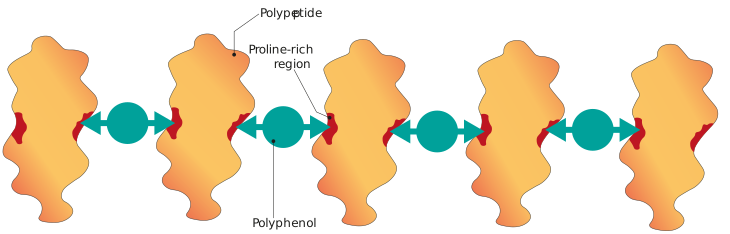
Figure: Formation of protein-polyphenol Haze in Beer
Further aggregation alongside the growth of protein-polyphenol haze complexes results in more stable covalent bonding. This in turn forms an insoluble permanent haze, which cannot be removed by heating. The brewer must remove the proteins and/or polyphenols from the beer before this permanent reaction occurs.