
Lesson 6 - Process Aids and Additions
This lesson discusses the function of process aids and how they improve colloidal stability. It also explores filter aids, post-fermentation additions, and the use of deaerated water as tools to enable a brewer to meet their final pack beer quality specifications.
Post-Fermentation Additions Plant
We have an infinite choice of flavour options at our disposal, but how do we ensure we add a controlled quantity at scale?
On a very small scale, it may be possible to add additions through the man-way door or by using inert gas (CO2 or N2) to blow the additions through a sample point port. But on a larger scale, these methods are not feasible.
A better solution is to use an additive dosing system to continuously and accurately add small amounts of liquid ingredients into the beer stream. Using this method ensures effective mixing for the duration of the beer transfer, typically from filter to bright beer tank. There are a large number of applications in processing carbonated beer. These additions plants are normally compact, and skid-mounted to provide a high degree of flexibility in manufacturing such products.
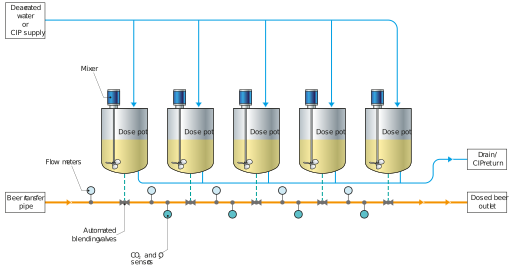
Figure: Additive dosing system
The additive dosing system is a series of dosing pots, connected directly to the beer transfer line either pre- or post-filtration. There are a series of in-line sensors that accurately measure the dose quantity in the beer. Before any liquid is introduced into the additive dosing system, it must undergo CIP to clean and sterilise it. It must then be flushed with deaerated water to displace any oxygen, otherwise we risk oxidising the beer and create staling flavours. Additions or flavours are pumped into dedicated dose pots and the pots are activated for use, depending on the addition requirements of each individual beer. A brewer may typically have the following additions in the additive dosing system:
-
PFB (post-fermentation bitterness), e.g. tetra or hexa iso-extracts
-
Hop oil for flavour enhancement
-
Caramel for colour adjustment
-
Specific flavours for late stage differentiation
For process control, sophisticated in-line sensors are used to determine product characteristics such as O2 or CO2, sugar content, and alcohol content. Reliable flow meters and pneumatic control valves permanently monitor and adjust the mass ratios. They also guarantee repeatable results and minimum product loss. The modular design of the process units allows for easy expansion, depending on the requirements for additional process aids or flavours.
For any of these post-fermentation additions or dilutions, we must reduce (if not eliminate) any oxygen getting into the product through this addition. We must thus ensure that we use deaerated brewing product water.