
Lesson 6 - Process Aids and Additions
This lesson discusses the function of process aids and how they improve colloidal stability. It also explores filter aids, post-fermentation additions, and the use of deaerated water as tools to enable a brewer to meet their final pack beer quality specifications.
Hop Aroma – Traditional Dry Hopping
Dry hopping primarily aims to impart hop aroma. This process can be carried out during cold maturation (as well as fermentation / warm maturation).
Various methods and equipment are available to the brewer, to help ensure that hops are added accurately, efficiently, and safely during dry hopping.
The chemistry of dry hopping, alongside its methods of addition, is covered in detail in the Hops unit in the first module of this course.
This section will briefly recap some of the details of dry hopping during cold maturation.
The amount of hops added will vary depending on beer style. There are no hard and fast rules, but a pilsner may only have 20 g/hL of hops added, whereas an American style IPA could have an addition of more than 500 g/hL.
However, we must approach dry hopping with caution!
Firstly, there are oxygenated hop compounds known as humulinones, which are particularly relevant to the brewer during dry hopping. These compounds are extremely soluble in beer. As they are approximately 66% as bitter as iso-α-acids, they can increase a beer’s bitterness during dry hopping.
For many years, it has been thought that dry hopping does not contribute bitterness to beer. However, the most recent research has shown that it can, especially if the original beer was low in bitterness prior to dry hopping. The bitterness imparted, however, tends to be smoother and less intense.
Below are links to some articles that explore this phenomenon in more detail:
-
E. Parkin, T. H. Shellhammer, “Toward understand the bitterness of dry hopped beer” Journal of the American Society of Brewing Chemists75, 363−368 (2017).
-
https://www.hopsteiner.com/uk/blog/breaking-science-dry-hopping-effects-bitterness/
Secondly, dry hopping leads to a small amount of secondary fermentation if yeast is present in the beer and the temperature is high enough. This is due to the increase in fermentable carbohydrates caused by enzymes found in the hops; this is known as ‘hop creep’.
This causes the beer’s gravity to decrease slightly and may cause the yeast to synthesise valine, forming α-acetolactate in the process.
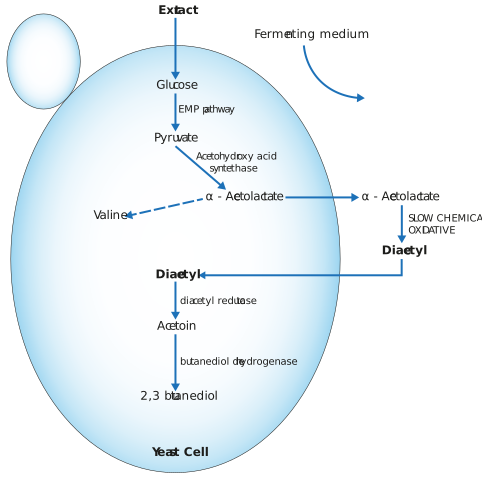
Figure: Formation of diacetyl
This can result in increased diacetyl levels, especially if dry hopping occurs post-warm maturation. If this happens, there are no means available to reduce the diacetyl again.
Some of the main factors affecting dry hopping efficiency include:
-
Particle size of hop – smaller particles have a larger surface area and thus the hop essential oils can be more efficiently absorbed into the beer.
-
Condition of lupulin glands – if the lupulin glands are ruptured immediately prior to dosing into the beer (not before, as this will lead to oxidation), the essential oils will be more accessible and thus more efficiently utilised.
-
Agitation – mixing the hops within beer causes hop oils to more efficiently transfer into the brew.
-
Contact time – there is an optimum contact time for extraction of dry hop flavour. Different oils are extracted and can decline in concentration at different rates, so the flavour profile changes over the period of extraction.
-
Yeast – yeast cells can bio-transform hop oil flavours.
Hop aroma – hop oil products
An alternative to dry hopping is to add hop oils post-fermentation. This imparts a fresh dry hop character. The advantage of aroma products is that they are completely soluble in beer and provide 100% utilisation in comparison to dry-hopping in cold storage. This means that a brewer can consistently achieve a completely reproducible aroma in their beer. Hop essences have also been developed that reproduce the effect of either late or dry hopping. This is covered in more detail in the Hops Products lesson in Diploma in Brewing Module1. In this lesson, we will cover just the relevant details.
The hop oils are generally separated commercially from ethanol or CO2 extracts via steam, vacuum distillation, or chromatography. The brewer then adds them to the beer in the form of an emulsion, or by re-dissolving them in liquid CO2. These oils have been fractionated to produce individual products that have, e.g. spicy, floral, or citrus characteristics. They are normally added to the beer at rates of 20-100 µg/L, depending on the desired hop aroma intensity. Another advantage of these oils is that they have very little influence on the sensory bitterness of the beer and therefore do not add astringency. Hop oils have been further developed to replicate specific hop varieties, such as Type Noble, which contributes a subtle and pleasant late hop aroma.
Let us re-cap the benefits of using hop products to enhance flavour and aroma post-fermentation:
-
Hop oil utilisation increased – no loss due to kettle evaporation
-
Beer losses reduced – less hop material left in whirlpool or hop back
-
Brewhouse throughput increased – shorter brew cycle time
-
Improved beer flavour stability
-
Improved hop aroma intensity
-
Improved balance in beer aroma/flavour
-
No polyphenol haze
The links below explain some of these hop products in more detail:
Note, this is for illustrative purposes only and is not a recommendation or endorsement of a particular supplier’s product.