
Lesson 6 - Process Aids and Additions
This lesson discusses the function of process aids and how they improve colloidal stability. It also explores filter aids, post-fermentation additions, and the use of deaerated water as tools to enable a brewer to meet their final pack beer quality specifications.
Polyvinylpolypyrrolidone (PVPP)
Polyvinylpolypyrrolidone (PVPP) is an adsorbent stabiliser that selectively binds the polyphenols that are responsible for chill and permanent haze.
It is insoluble in beer and therefore needs to be mixed with water before use, this allows the PVPP to swell. One of the greatest benefits of PVPP is that it does not affect foam forming proteins. It is also claimed that PVPP does not remove the polyphenols that help improve flavour stability. If this is true, PVPP should improve colloidal stability while having no negative effect on foam potential or flavour stability.
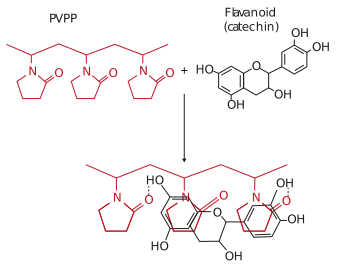
Figure: PVPP interaction with polyphenols
PVPP is used in two forms, both in a powder format:
-
Single-use PVPP – This powder is made of micronised fine particles that are very small but provide a large surface area. The desired contact time is very short, only 5-10 minutes. In this form, it can be dosed directly into the cold conditioning (maturation) tank at a rate of 10-40 g/hL or dosed pre-filter, often in combination with other agents such as silica gel and papain (a proteolytic enzyme). PVPP binds with polyphenol complexes and is then removed on the filter.
-
Regenerable PVPP – This powder comes in a larger particle form. It has a greater mechanical strength than the single-use type but provides a smaller surface area and therefore adsorbs fewer polyphenols. Unlike other clarification aids that are dosed prior to primary filtration, a regenerable PVPP filter is located post-primary filter and delivers a typical dose rate of 30-50 g/hL of PVPP into the beer.
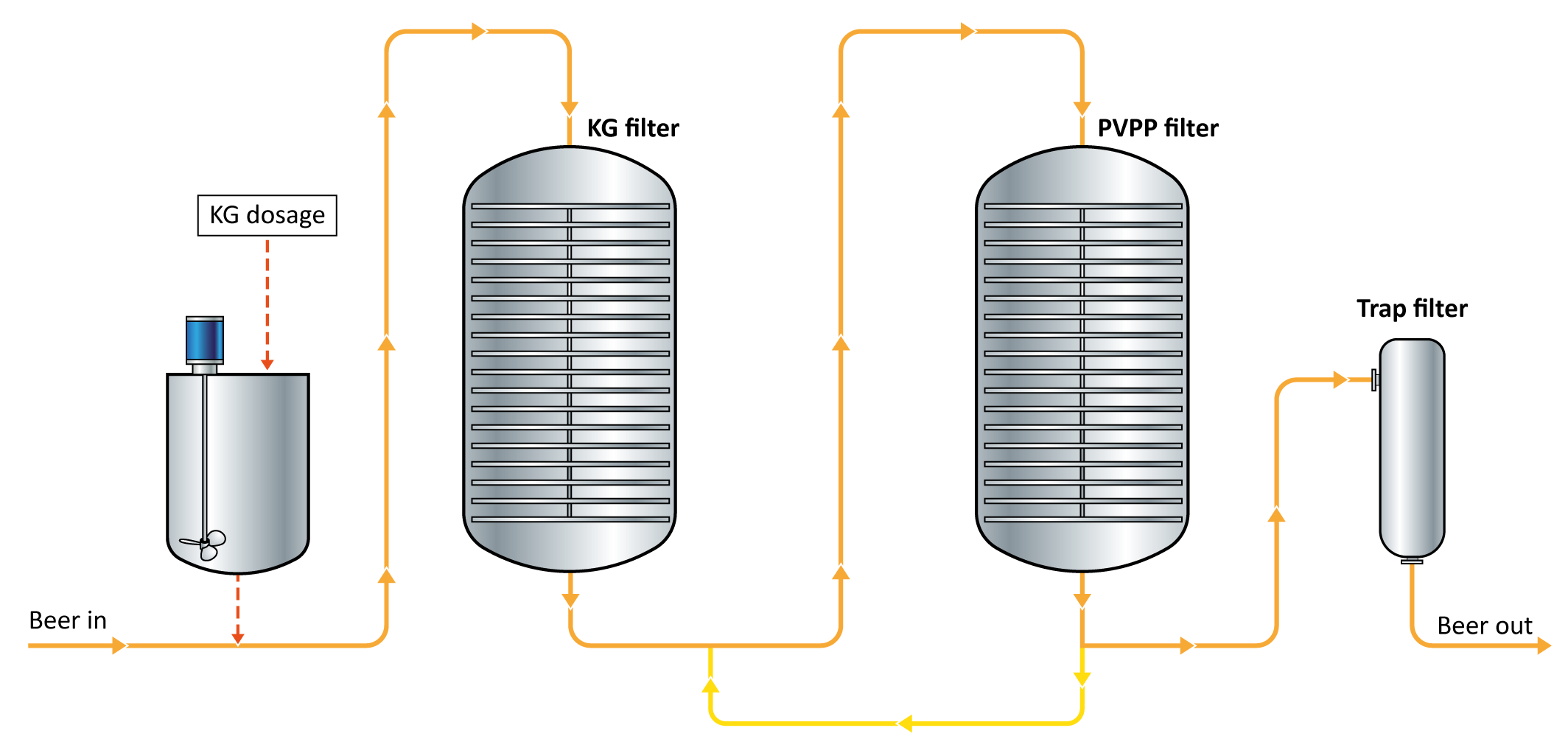
Figure: Diagram PVPP filter
Regenerable PVPP format can be regenerated and reused several times. Once the PVPP has become fully loaded with polyphenols, we can wash out the polyphenols from the PVPP with hot caustic soda, which regenerates it for reuse. The caustic breaks the bonds between the polyphenol and PVPP. It is then rinsed with dilute acid to bring the pH down to 4 and wash out any carbohydrates or salts trapped in the filter. The filter is then rinsed with water and the PVPP is ready for reuse.
Regeneration does cause a small loss of PVPP, generally around 0.5% per regeneration. This means that the PVPP must be periodically topped up.
Regenerable PVPP may appear an expensive option as it needs a separate plant and topping-up incurs extra costs. However, when calculating the premium cost for the regenerable option and the capital cost for an additional filter, the operating cost is far less than with a single-use PVPP. Larger breweries making beers with longer shelf lives, tend to prefer this option.
Let's recap the use of single-use and regenerable PVPP, and outline what a brewer should consider when selecting the most appropriate format for their brewery:
Table: Single-use vs regenerable PVPP – advantages and disadvantages
|
Single-use PVPP |
Regenerable PVPP |
||
|
Advantages |
Disadvantages |
Advantages |
Disadvantages |
|
No extra filter system needed |
Continuous cost for single-use PVPP |
Low PVPP consumption (0.5-1 % loss) |
Higher equipment costs due to separate PVPP filter and consecutive trap-filter |
|
Stabilisation of small batches |
Optimum efficiency achieved only after pre-clarification with a separator |
Full automation |
|
|
Higher adsorption due to smaller particle sizes |
Effect on the filter life circle |
Good control of stabilisation |
|
Whilst the application of PVPP does not guarantee a longer shelf-life, removing oxidisable polyphenols can increase a beer’s shelf-life by up to 20 times.
For the most effective stability treatment, research has shown that a combination of both silica gel and PVPP (for example Polyclar Plus – see table below) is the best option. In addition to removing polypeptides, tannoids, and tannoid precursors in the beer, it also acts as a filter aid, improving filtration run times. We will cover filter aids and their impact on filtration more in the Filtration lesson.
Table: Research showing the additional benefit of combined silica gel and PVPP product on filter run length
|
Stabiliser |
Addition rate (g/hL) |
Change in pressure over time (∆p/h) |
Filter run time (h) |
|
Xerogel only |
36 |
0.49 |
6.4 |
|
PVPP only |
13 |
0.35 |
7.4 |
|
Polyclar Plus 730 |
33 |
0.25 |
12.0 |
The use of PVPP and silica products is not necessary for all beers but it helps to further reduce the risk of any haze formation in the packaged beer. The combination is often applied to export beer, where handling conditions are not well-controlled, and the beer requires a long shelf-life (more than 40 weeks). For beer with a shorter shelf life, less expensive silica treatment is often sufficient on its own for controlling the risk of haze formation in final pack.