
Lesson 6 - Process Aids and Additions
This lesson discusses the function of process aids and how they improve colloidal stability. It also explores filter aids, post-fermentation additions, and the use of deaerated water as tools to enable a brewer to meet their final pack beer quality specifications.
Silicates and Silica Gels
All haze-forming proteins originate from malt. The proteins most associated with haze formation are those containing proline.
Other proteins in beer provide foam stability. When using process aids, we must remove haze forming proteins and leave the proteins with foam potential. Silica gels achieve this.
Silica gels are used as protein adsorbents and come in two forms, hydrogel (> 30% water) and xerogel (< 10% water). They are prepared by acidifying sodium silicate solutions, which in turn forms a hydrosol. The hydrosol sets to a gel, which can then be milled and dried to produce powder. This produces hydrogels and xerogels containing 65% and 5% moisture respectively.
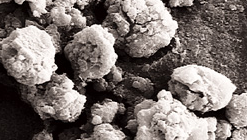
Figure: Silica hydrogel particles
Three forms of silica powder are available. Silica can also be purchased in liquid form but rarely is.
Table: Silica gel types and properties
|
|
Hydrogel |
Hydrated Xerogel |
Xerogel |
|
Solids |
35% |
65% |
90% |
|
Pore volume |
1.8-2.0 |
1.5 |
1.0-1.2 |
|
Surface area |
> 700 m2/g |
550 m2/g |
500 m2/g |
|
Pore diameter |
10-12 nm |
10 nm |
6-9 nm |
|
Permeability |
180-350 md |
100 md |
23 md |
We can add silica at various points throughout the brewing process. The most common addition points are into the maturation vessel or dosed into the beer stream during transfer to the filtration buffer tank. Adsorption is achieved within a very short contact time.
What is the difference between absorption and adsorption? Absorption is when a fluid is dissolved by a liquid or a solid (absorbent). Adsorption is when atoms, ions, or molecules from a substance (gas, liquid, or dissolved solid) adhere to a surface of the adsorbent.
Silica is made up as a slurry in cold deaerated water at 10-25% w/w and dosed proportionally across the entire beer run. 80% of adsorption is achieved in less than three minutes between the silica and beer. Addition dose rates are normally between 20-120 g/hL.
Therefore, silica is ideal for use ‘in-line’ as the beer transfers into the filtration buffer tank. This is because it does not require extended contact time with beer in tank, unlike other process aids such as isinglass, which requires greater than 24 h contact time. Silica gel is then removed during filtration, along with the haze-forming proteins it has bound with.
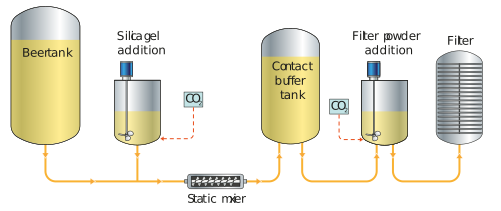
Figure: Illustration of a silica dose system