
Lesson 6 - Process Aids and Additions
This lesson discusses the function of process aids and how they improve colloidal stability. It also explores filter aids, post-fermentation additions, and the use of deaerated water as tools to enable a brewer to meet their final pack beer quality specifications.
Finings
The most commonly used type of finings is isinglass. Isinglass contains 98% soluble collagen, derived from the swim bladders of tropical and sub-tropical fish. We use it to clarify yeast from beer.
Other types of finings (known as auxiliary finings, derived from various materials such as silicates and seaweed!) electrostatically attract and entrap proteins in the same way as isinglass.
By using finings, we can increase the size and mass of haze forming particles, allowing faster precipitation according to Stokes’ law (as we learnt in the Warm and Cold Maturation lesson).
Watch this clip to understand the principle action of process aids on wort and beer:
Note, this is for illustrative purposes only and is not a recommendation or endorsement of a particular supplier’s product.
Isinglass is made up of collagen, arranged in a triple helical structure and containing many sites that have a positive charge. It is much larger than a yeast cell and the negatively charged yeast cells are then attracted to the isinglass, with the isinglass accumulating many yeast cells and forming a floc, which sediments to the bottom of the vessel.
Isinglass finings can flocculate and sediment out more than 95% of the suspended yeast cells and greater than 90% of the protein particles of haze forming size. It has been calculated that this equates to removing 30 times its own dry weight of suspended solids.
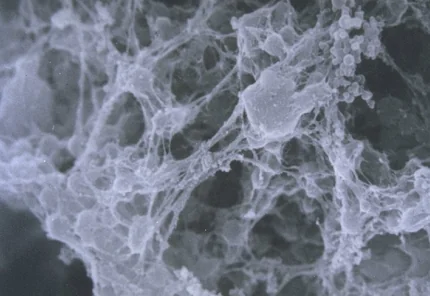
Figure: Yeast cells electrostatically entrapped in isinglass collagen
We can use isinglass application at various stages of the brewing process. When we use it depends on the packaging format. Traditionally, isinglass was used for clarifying cask ale in the UK. However, it is now also used as a pre-treatment for filtered beers. Either way, it is added post-fermentation and is regularly added to the beer stream after centrifugation, with a desirable contact time of > 24 h for effective beer treatment. In this instance, it is used to remove small protein particles that may have passed through the centrifuge. Dose rates vary; for filtered beers, a brewer typically uses 1-3 g/hL in either liquid form, finely milled powders, or pre-hydrated pastes (depending on local availability). The brewer must optimise their addition rate based on their actual base beer, as a number of factors can affect the isinglass’ effectiveness. These factors include the flocculence of the yeast strain, the protein/polyphenol concentration, pH, calcium levels, and magnesium content.
We can also use gelatin as a fining agent. Gelatin is a protein derived from cows, pigs, or fish sources. It is prepared by making a dilute solution in hot water, cooling it, and then adding it to the beer post-fermentation. Gelatin works in a similar manner to isinglass, although not as effectively. Gelatin has an amorphous structure (without form or structure), it tends to bind less tightly to yeast than the highly ordered helical structure of isinglass. As a result, gelatin is usually only used to clarify beer that is served from an undisturbed vessel. Otherwise, the complexes could easily break apart, causing haze formation.
In recent years, as they are animal products, there has been some controversy over the use of isinglass and gelatin in beer. Their current use is thus not as widespread as it once was. Beer labelled as vegan cannot be treated with isinglass or gelatin. To remain compliant with labelling regulations, a brewer must thus select an alternative clarification agent.
There are other non-animal-based products available to the brewer, such as auxiliary finings.
Traditional auxiliary finings include acidified silicates, polysaccharides such as gums, and seaweed extracts (carrageenan or alginate). They all come in the form of colloidal solutions and carry a negative charge, thus attracting positively charged proteins (including the collagen in isinglass!). In a similar fashion to isinglass, the auxiliary finings form flocs with these proteins and sediment out of the beer. We should add auxiliary finings roughly 24 h prior to adding isinglass. This will prevent the auxiliary finings from removing the isinglass before it has had the opportunity to remove yeast.
Alternative materials have been tested at laboratory and pilot brewery scale, such as pea protein extract. Brewery trials have compared isinglass and pea extract as fining agents. These trials showed few significant differences between the beers. The trials concluded that pea extract worked just as effectively as isinglass and would make an excellent vegetarian alternative. However, further work is needed to scale up the production of pea extract in order to make it an economically viable option for use within brewing.