
Lesson 4 - Clarification – Centrifugation
This lesson discusses beer clarification via centrifugation. Clarification removes yeast and solid particles from the beer in order to make it ‘bright’ or reduce the amount of haze. Centrifugation is one method that we can use to clarify beer. This lesson looks closely at the physics of centrifugation and the concept of accelerated gravitational force. By the end of the lesson, you should understand the importance of this process and its impact on final beer quality.
The Design and Operational Principles of Centrifuges – Decanter Clarifiers
Decanters are generally used if the solid content is high. They are usually used for water treatment and trub separation in the brewhouse.
However, a decanter can also be used to process tank bottoms that have up to a 60% solids volume. The main design difference in comparison to a disc-stack (self-cleaning) centrifuge is a rotating screw, housed within a casing, which discharges solids at the end. Processed liquid discharges at the opposite end of the decanter and moves forward to the next process. Due to the higher solids loading, these centrifuges operate at a lower speed, typically around 40 hL/h. For this reason, decanters are not used for processing beer between fermentation and maturation vessels.
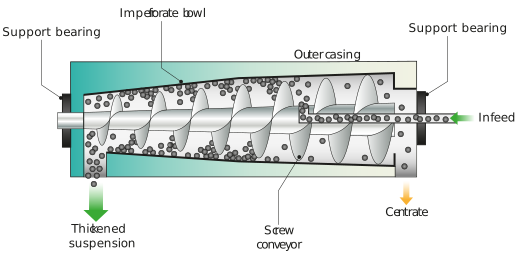
Figure: Decanter clarifier
The following video clip shows how the decanter centrifuge operates:
Commercial examples of this method include :
Alpha Laval Foodec range: Alpha Laval Foodec range
GEA gMaster CF: GEA pMaster CF
Flottweg Sedicanter: Flottweg Sedicanter
Note, this is for illustrative purposes only and is not a recommendation or endorsement of a particular supplier’s product.
The following design features can make a decanter centrifuge an attractive solution to processing maturation vessel bottoms:
- To maintain beer quality, decanter centrifuges are installed with an inert gas (such as CO2) purge facility to prevent oxygen pick-up. This function reduces the risk of beer staling and off-flavour development during the maturation phase.
- In addition, due to the increased loading capability of a decanter centrifuge, there is no need to dilute tank bottoms before processing. This is a significant water saving for a brewery and helps create a more sustainable operation.
- A compact yeast cake is generated when in operation. This creates a high dry substance content, with solids of between 25 and 28% by weight. Higher dry substance content means higher beer yields.
So, to re-cap, we have now learnt about the practical applications of centrifuges and the benefits they give to a brewery. They increase sedimentation rates and reduce beer process times. We have explored the types of centrifuges that a brewer may want to consider. Let us now consider the pros and cons of running a centrifuge in your brewery.