
Lesson 4 - Clarification – Centrifugation
This lesson discusses beer clarification via centrifugation. Clarification removes yeast and solid particles from the beer in order to make it ‘bright’ or reduce the amount of haze. Centrifugation is one method that we can use to clarify beer. This lesson looks closely at the physics of centrifugation and the concept of accelerated gravitational force. By the end of the lesson, you should understand the importance of this process and its impact on final beer quality.
Theory of Centrifugal Sedimentation
In the Warm and Cold Maturation lesson, we discussed how a brewer can use Stokes’ Law to understand and manipulate the sedimentation process.
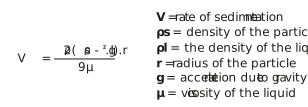
Figure: Stokes’ Law
As a reminder, this equation describes the force required to move a sphere through a fluid at a particular velocity. We looked at the variables that could increase the rate of settling during maturation and examined how a brewer can influence this.
A centrifuge can maximise particulate acceleration due to gravity by spinning at high velocity and increasing the gravitational force on the particle.
So how does this impact the operating philosophy of a centrifuge? This will change depending on the liquid’s composition at the centrifuge inlet. A beer’s liquid density may vary depending on how effectively the beer has sedimented out in the fermentation vessel. If the beer is turbid (e.g. if there is a high concentration of suspended solid particles), the flow rate into the centrifuge will slow down. By slowing down the flow of beer into the centrifuge, it allows a greater removal of particles which would otherwise pass through. Likewise, if the turbidity improves and particle concentration decreases, the flow into the centrifuge will increase.
There is a fine balance between centrifuge flow rate and solid particle removal. A centrifuge needs to run efficiently in a brewery at a flow rate that allows sensible beer transfer rates from fermentation to maturation vessel. In a medium to large sized brewery, flow rates such as 200-250 hL/h allow regular vessel turnaround times, without negatively impacting beer residence time in tank.
Let us explore gravitational force more closely and the effect of acceleration. Centrifuges increase gravitational force to allow a more rapid separation and removal of sedimented haze forming particulate material and yeast (as we have discussed previously.) To understand this effect a little further, a centrifuge running at 5,000 rpm can have an 8,000 increase in gravitational force!
To calculate this, we can use the following formula:
g = ω2r
g is gravitational force, ω is rotational speed in radian/second and r is the radius in metres.
The sedimentation rate is further dictated by the settling distance. Reducing this is a key design feature of the centrifuge. To reduce the settling distance, discs can be inserted into the centrifuge.
So, in summary, for an effective centrifugation of beer, there needs to be a combination of:
-
Increased rotational speed (accelerated gravitational force)
-
Increased particle radius (formation of protein and polyphenol complexes and flocculated yeast)
-
Reduced settling distance (insertion of centrifuge discs)
These three effects combined will accelerate the sedimentation rate.