
Lesson 4 - Clarification – Centrifugation
This lesson discusses beer clarification via centrifugation. Clarification removes yeast and solid particles from the beer in order to make it ‘bright’ or reduce the amount of haze. Centrifugation is one method that we can use to clarify beer. This lesson looks closely at the physics of centrifugation and the concept of accelerated gravitational force. By the end of the lesson, you should understand the importance of this process and its impact on final beer quality.
The Design and Operational Principles of Centrifuges – Self Cleaning Clarifiers
Let us now look at the different types of centrifuges and their use within the brewery. The two main types are self-cleaning clarifiers and decanter clarifiers, which are used to separate out yeast and particulate matter.
Self-cleaning centrifuges, also known as disc stack centrifuges, operate with low solids contents. They process entire vessels during beer transfer, typically from fermentation to maturation tank. These centrifuges operate ineffectively when the solid content is high, e.g. when the vessel or tank bottoms have high amounts of yeast and particulate matter, such as spent hops. Where there is a requirement for a high solid content, a decanter centrifuge is the preferred technology.
Self-cleaning centrifuges are best for processing low solids content, whereas decanter centrifuges can handle much higher solid loadings.
Let us look more closely at both types of centrifuge, starting with the self-cleaning clarifier.
Self-cleaning centrifuge (clarifier)
As mentioned previously, this centrifuge is most commonly used between the fermentation and maturation vessel, as solid contents are relatively low, typically up to 30% solids. During operation, solids are discharged at frequent intervals whilst the centrifuge operates at full speed. This is called bowl discharge or de-bowling. The bowl contains a series of parallel discs, the gaps between these discs are usually 0.5-2.0 mm and are separated by pieces called chaulks. Yeast and other particulate solids collect and slide off the disc surface, collecting on the surface of the bowl. Clarified beer moves towards the centre of the centrifuge and exits the top, before being pumped to the next stage, the maturation vessel:
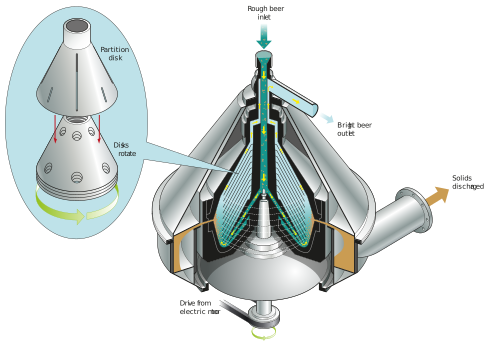
Figure: Self-cleaning clarifier – disc stack centrifuge
These clips show how the disc stack (self-cleaning) centrifuge operates (this is not a beer example):
Commercial examples of this method include:
Note, this is for illustrative purposes only and is not a recommendation or endorsement of a particular supplier’s product.
Depending on the solid content, a typical rate of operation can be between 40-600 hL/h. As a general rule of thumb, the higher the solids content, the slower the rate of operation. The yeast and solid material are removed via a mechanism where the spinning bowl rapidly opens (solids ejection) and the solid sludge is ejected into a discharge system.
The frequency of ejection can be based on a pre-determined time or dictated by hydraulic differential pressure, which senses the accumulation of solids in the bowl. Advanced set-ups include automated ‘self-thinker’ control systems, which will monitor centrifuge feed and turbidity conditions and will ascertain the right time to eject the bowl. Breweries have their own reasons for either time or differential pressure de-bowling; this may be driven by historical data, processing trends, or recipe design. Process losses may be higher if de-bowling is based on time. This is because the solid sludge volume will not be taken into consideration. The bowl may only be partially full, yet the same volume is discharged.
These centrifuges run most efficiently when they receive a steady stream of uniform concentrations of solids into the liquid feed. We can achieve this by cropping yeast from the beer in fermentation vessel prior to centrifugation or by using powdery yeast strains (low flocculant strains). These strains generally contain yeast that is evenly distributed throughout the beer, rather than yeast that has settled to the bottom of the fermentation vessel. In both scenarios, the beer’s composition will be consistent throughout the transfer from fermentation to maturation vessels.