
Lesson 4 - Clarification – Centrifugation
This lesson discusses beer clarification via centrifugation. Clarification removes yeast and solid particles from the beer in order to make it ‘bright’ or reduce the amount of haze. Centrifugation is one method that we can use to clarify beer. This lesson looks closely at the physics of centrifugation and the concept of accelerated gravitational force. By the end of the lesson, you should understand the importance of this process and its impact on final beer quality.
Centrifugation System Considerations
The point at which yeast is removed from the brewing process will differ between breweries.
Some brewers will want to remove the main crop of yeast as soon as primary fermentation is complete. This will help prevent any yeast autolysis and potential negative impacts on flavour and colloidal stability (referred to as warm crop).
Other brewers prefer to remove the yeast as late as possible. This allows the yeast to mop up any oxygen that dissolves into the beer during beer processing and helps prevent oxidation of the beer (referred to as cold crop).
Based on these two models, the brewer may want to use the centrifuge between fermentation and cold maturation, or between cold maturation and filtration.
However, yeast can aid filtration by acting as a filter bed to trap smaller particles. It is thus wise to have around 0.2 million cells/mL in the beer going onto the filter, whether you centrifuge warm or cold.
Let us look at a typical centrifuge design and set-up when located between a fermentation vessel and a maturation vessel:
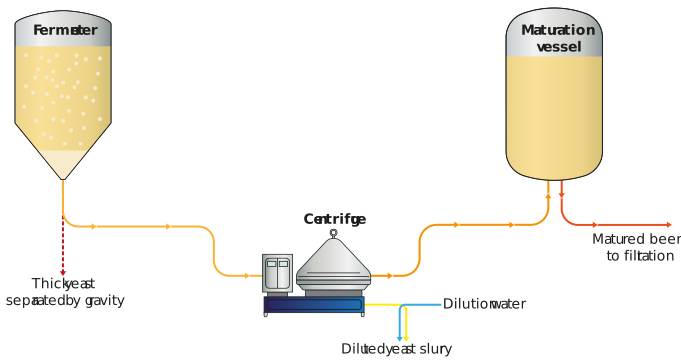
Figure: Illustration of a centrifuge arrangement in a brewery
After the main bulk of yeast is cropped from the fermenter, beer is pumped through the centrifuge to clarify the beer. It is then chilled and pumped into the maturation vessel for cold storage. The end product of centrifugation is a thick yeast slurry, containing other solid material such as cold break, which is then diluted and pumped to a spent (no longer used for brewing) yeast collection vessel. This excess yeast is then sold as a brewery co-product (for example, used in yeast extract products such as Marmite) or processed through the brewery effluent plant. It is possible to recover the yeast from centrifugation and re-pitch it into another brew, but the centrifugation process may damage the yeast cells. Extensive yeast quality checks should thus be conducted before re-using this yeast.
Some brewers may not filter the beer, but will instead use the centrifuge for rough clarification directly before the bright beer tank (BBT) or final product tank (FPT), or even just prior to packaging. Although the beer is unlikely to achieve the same level of ‘brightness’ as a filter, this clarification method will remove the majority of yeast cells and solid particles, such as cold break and spent hop material.
Other than point of use, what are the other essential features of a centrifugation system? Let us summarise them:
-
Beer turbidity control: This is probably the most important measurement on a centrifuge. Turbidity is where the transparency of a liquid reduces. It is caused by the presence of undissolved substances such as yeast and cold break. We want our beer to be of a specified clarity, so we need to remove these undissolved substances to increase its transparency. This can be measured continuously as the beer exits the centrifuge (called centrate); we assess its visual appearance at the same time.
-
Cleaning and sanitation: The centrifuge must be designed to allow effective cleaning (which will remove organic soiling) and sterilisation (which will remove any microbial activity).
-
Capacity: The centrifuge must be sized appropriately to meet the brewery’s demands, especially during peak production periods.
-
Ancillary equipment and process control: The process requires transfer through process equipment from one vessel to another vessel. There should be no microbiological contamination or oxygen ingress. The essential components of the system include transfer pumps, temperature control via beer chillers, inert gas (either CO2 or N2) and a compressed air supply, which is controlled via automation.
-
Containment: Centrifuges are very loud and far exceed noise safety levels of 90 dB! To manage the high noise levels during operation, a centrifuge is positioned in a dedicated room or acoustic enclosure.