
Lesson 5 - Fermentation and Beer Flavour SAQ
This lesson enables you to test yourself on the material covered in the Fermentation and Beer Flavour lesson and determine to what level you have attained the outcomes.
Suggested Response - Q5
**You have set up a brewery in a new location. Your analyses of the local water indicate that the content of sulphate is 150 mg/L. You do not have access to a water purification plant. You intend to brew pale lager beers using worts with a relatively low content of malted barley and high proportion of sugar adjunct. What effects might this combination of circumstances have on yeast sulphur metabolism during fermentation and on beer flavour? What steps might you take in response to the water analysis?
Response:
The information provided in the question indicates that the worts will have a relatively high sulphate content and quite low FAN, as a result of the low ratio of malt to adjunct.
In these circumstances we need to consider how yeast will respond to this set of growth conditions.
Yeast requires sulphur-containing amino acids, such as cysteine and methionine. It can take these up from the wort or it can synthesise them. The sulphur atoms needed for the syntheses can come from inside the cells via turnover or from the inorganic sulphur-containing components of the medium, such as sulphate. The uptake of sulphate requires energy in the form of ATP which indicates that this would not be the first choice of the cell.
The pathway for sulphate assimilation is shown in the following figure (note the energy requirement):
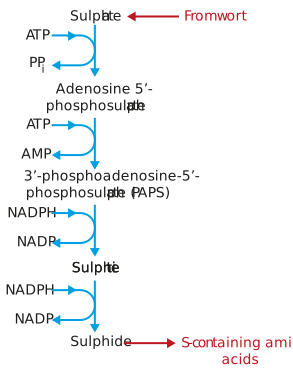
Figure: Pathway for the uptake of sulphate by yeast
The control of the various pathways is related to how much growth occurs in fermentation.
The first and easiest option is that the yeast will take up S-containing amino acids and incorporate these directly where required. Control is via the intracellular concentration of a compound called S-adenosylmethionine. When the concentration of this is high, the genes for sulphate assimilation are repressed.
Where conditions favour growth, the exhaustion of sulphur-containing amino acids falls and so does the concentration of S-adenosylmethionine. This relieves the repression and sulphate uptake can occur. Under these conditions the sulphur is all used for the synthesis of sulphur-containing amino acids.
If growth is restricted, as will possibly be the case here, the sulphate uptake pathway remains active but SO2 and H2S accumulation can occur as the demand for sulphur-containing amino acids has fallen.
In the scenario outlined in the question this could result in producing a beer with a flavour defect in the form of H2S.
The actions that might be taken to deal with this are quite limited if no capital is available. The most obvious step would be to remove the sulphate at source by installing water purification. If this was not acceptable, a limiting approach would be to avoid any other additions of sulphate, so making sure that additions of calcium to mash and copper are in the form of calcium chloride.