
Lesson 5 - Fermentation and Beer Flavour SAQ
This lesson enables you to test yourself on the material covered in the Fermentation and Beer Flavour lesson and determine to what level you have attained the outcomes.
Suggested Response - Q1
*Answer BOTH parts of this question, where necessary using diagrams:
a) Describe the pathways which give rise to higher alcohols in beer and how their activities relate to wort composition.
b) Discuss possible reasons why yeast cells synthesise higher alcohols.
Response:
a) High alcohols are synthesised by yeast during fermentation by two routes and these are called the anabolic and catabolic pathways. In both cases the starting point is an α-ketoacid. In the anabolic route the α-ketoacid is derived from pyruvate, itself largely formed via glycolysis. In the catabolic route, also called the Ehrlich pathway, the α-ketoacid is formed from transamination of an amino acid. The α-ketoacid is then decarboxylated to give an aldehyde and this is reduced via an NAD-linked dehydrogenase to form the alcohol.
The biosynthesis of higher alcohols via these two routes is shown in the following figure.
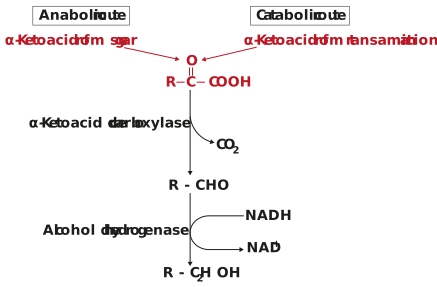
Figure: Final steps in the synthesis of higher alcohols
b) The contribution made by the two routes is roughly equal but changes as the fermentation proceeds and is also influenced by wort composition. The most important factor seems to be the initial wort FAN concentration. Generally, the more FAN, the greater the contribution of the catabolic route. Similarly, this pathway is more active in early fermentation when FAN uptake is maximal. In later fermentation, the anabolic route becomes more important.
Two potential roles for higher alcohols have been suggested. The first of these is for redox balancing. This function explains the link between yeast growth and the quantity of higher alcohols synthesised. During fermentation, NADH formed during glycolysis is largely re-oxidised by the reduction of acetaldehyde to ethanol. However, this balance is imperfect because a proportion of the carbon from pyruvate is diverted into other pathways which ultimately result in the formation of yeast biomass. This means that other redox balancing routes are needed and high alcohol formation fulfils this role. The more carbon that is diverted, the more growth there is, which leads to a greater need for redox balancing and therefore a greater quantity of higher alcohols being formed.
It seems that higher alcohols also function as secondary messaging systems. Specific higher alcohols, such as phenylethanol, respond to the onset of nutrient limitation by triggering the morphological and metabolic changes associated with passage into the stationary phase of fermentation.