
Lesson 5 - Fermentation and Beer Flavour SAQ
This lesson enables you to test yourself on the material covered in the Fermentation and Beer Flavour lesson and determine to what level you have attained the outcomes.
Suggested Response - Q2
**Answer BOTH parts of this question:
a) What contribution do ATF genes in yeast make to beer flavour?
b) Discuss the relationship between oxygen and the activity of the ATF genes.
Response:
a) The ATF genes code for the enzyme alcohol acyl transferase. Most brewing yeast strains have at least two of these genes, called ATF1 and ATF2. The enzyme products of the genes catalyse the terminal step in ester formation where an alcohol (usually ethanol) and an acyl ester, formed with a coenzyme (usually acetyl-Coenzyme A), react to give free Coenzyme A and an ester.
The two final stages in ester synthesis are shown in the following figure:
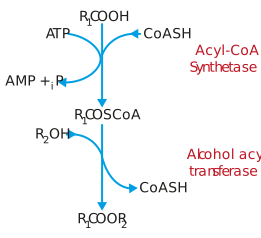
Figure: Terminal steps in the synthesis of esters.
The last step is coded for by the ATF genes.
b) The ATF genes are highly regulated and oxygen plays a key role. Esters may have several metabolic functions but one important role appears to be the control of free Coenzyme A. This coenzyme plays a part in many vital enzymatic reactions where it is a carrier of other chemical groups. In order for metabolism to continue, the cell needs ways of generating free Coenzyme A. From the figure shown above it can be seen that the free coenzyme is a product of the final step in ester formation.
A major pathway in which Coenzyme A is required is that leading to the formation of the key membrane lipids: unsaturated fatty acids and sterols. Both of these require molecular oxygen. We know that increasing oxygen concentration in early fermentation encourages more yeast growth in fermentation. This is because more of these essential lipids are formed and, therefore, more growth can occur in the subsequent anaerobic phase of fermentation. Under these conditions it makes sense not to use the ester-forming route for free Coenzyme A regeneration and so oxygen represses the ATF genes.