
Lesson 6 - Yeast Propagation
This lesson explores yeast propagation, the supply of pitching yeast and its fitness for purpose. We will explore yeast cultures and the protocols for its storage, along with how to propagate new cultures within the laboratory. This knowledge will enable us to demonstrate an understanding of the design features required for a yeast propagation plant.
Point of Reflection – Reconvene
Welcome back! So, what were your thoughts?
Our answers should be focused on the quality assurance of the propagation process. We agreed earlier that the process is only as good as the weakest link. Here, we have purposely introduced that seriously weak link.
If we continue with the culture recycling method, we have lost control of the chain that should ensure the yeast strain taken out of storage and checked for identity and purity is the same as the one we eventually end up brewing with. The more times we short-circuit the system, the greater the risk of change.
Modern propagation systems
Modern designs are made to be high-yielding in a short period of time. This is achieved with a combination of operation at a warm temperature, giving rapid growth rates, and ensuring that conditions are continuously aerobic.
A brief note on oxygen transfer: in brewing, we are more used to keeping oxygen out than actually making efforts to add it in, so this area may be new to many of us, and it is not an easy task.
-
Yeast can only take up oxygen when the gas is dissolved in a liquid.
-
In our case, this is wort and oxygen, which is not particularly soluble in this liquid because of the high levels of solutes it contains. Warm temperatures also reduce oxygen solubility.
-
Supplying yeast with oxygen means that we need a method of driving oxygen from the gas phase into the liquid.
Let us consider some of the physics at this point.
The rate of oxygen transfer is equal to:
kLa (c* – c) mol L min-1 h-1
Where kL is the mass transfer coefficient, a is the bubble surface area/ unit volume, c* is the equilibrium oxygen concentration and c the dissolved oxygen concentration.
kL is a constant for the particular system being tested; therefore, the main assumption is that the key factor is the surface area of the interface between the gas and liquid phases.
To achieve efficient oxygen transfer we have to maximise this surface area; this is done by generating lots of small bubbles. To do this, there has to be a method of really efficient stirring.
This is demonstrated by the data in the following figure.
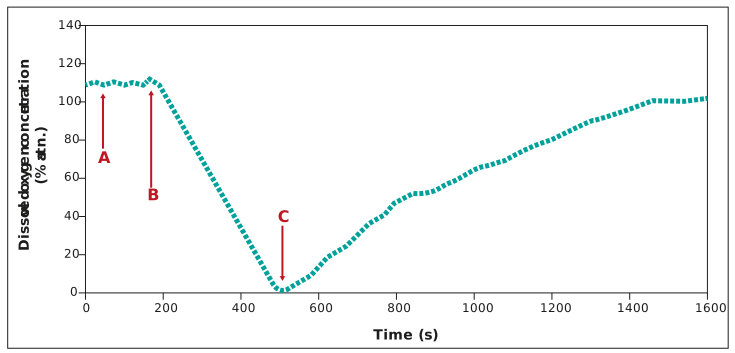
Figure: Oxygen concentration measured in a propagation plant with an operating volume of 140 hL and fitted with a heavy-duty mechanical stirrer
At point A, the vessel contains around 200 million cells per ml. Pure oxygen is being added at a rate of 150 L min-1. The vessel contents are being continually stirred. The dissolved oxygen concentration is constant, meaning that the rate of oxygen transfer is precisely matched by the rate at which it is being consumed by the yeast cells.
At point B, the conditions are exactly the same, but the stirrer has been turned off. The rate of oxygen transfer drops and so the dissolved oxygen concentration rapidly falls since the rate of oxygen transfer is now less than the rate at which it is being taken up by the yeast.
At point C the stirrer is turned back on, and equilibrium conditions return to those as seen at point A.
A two-tank propagation plant designed to have efficient oxygen transfer characteristics is shown in the following diagrams.
The first diagram (A) shows the essential features of a continuous aerobic propagation vessel. As can be seen, the key features are good hygienic design and provision of a means of ensuring efficient oxygen transfer. The second diagram (B) shows the features of a brewery propagation system based on these principles.
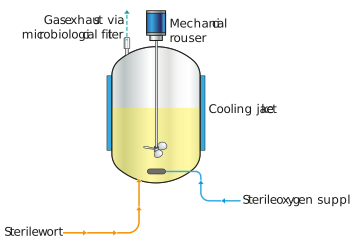
Figure: (A) Outline design for a high-yielding aerobic propagator
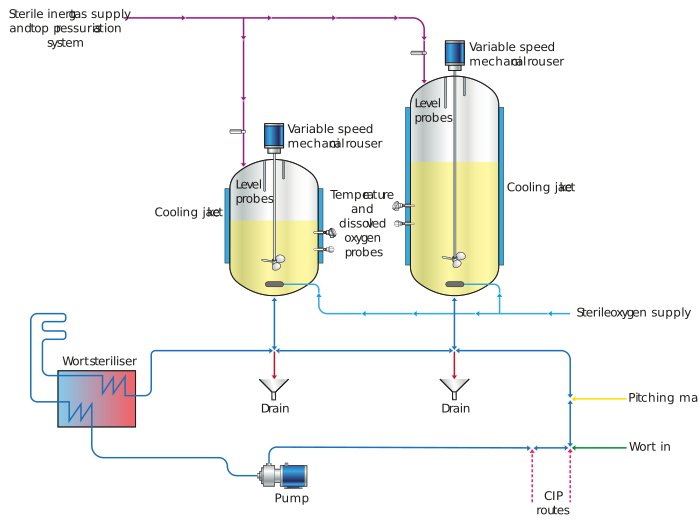
Figure: (B) Continuously oxygenated two-tank propagation plant
The two tanks have operating volumes of 8 and 140 hL, respectively. Both are supplied with a method for delivering sterile oxygen and a heavy-duty stirrer designed to give efficient oxygen transfer. Internal baffles increase the turbulence of mixing. Cooling is via external jackets. Wort is delivered via a dedicated plate heat exchanger. A system of top-pressuring reduces the risks of contamination and helps to control foaming.
Using this system with 15 °P malt wort, continuous oxygenation to give a constant dissolved concentration of approximately 8 mg/L and a temperature of 25 °C, a terminal cell count of 200-240 million cells per ml, viability 98%, was achieved in 24 hours.
The growth curve is shown in the figure below:
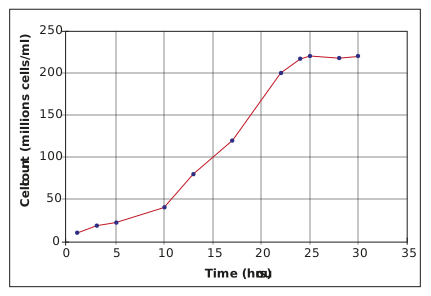
Figure: Yeast growth curve during continuously oxygenated propagation