
Lesson 6 - Yeast Propagation
This lesson explores yeast propagation, the supply of pitching yeast and its fitness for purpose. We will explore yeast cultures and the protocols for its storage, along with how to propagate new cultures within the laboratory. This knowledge will enable us to demonstrate an understanding of the design features required for a yeast propagation plant.
Managing Propagation Schedules
It is possible that some breweries might handle just one yeast strain and only replace it occasionally; others might have to deal with several different strains and limit the number of cycles of re-pitching.
Whatever the scale of the operation some planning is needed, such as:
-
From laboratory to brewing will take, at best, a couple of weeks and often a lot longer.
-
A new culture often called a yeast line, is never mixed with a different line and records are kept of how many times (generations) it has been pitched, which fermentation it came from and where it went next.
-
The planning system has to identify which yeast lines are reaching the end of their chosen number of pitches, and have a new culture ready, at the right time, to replace them when they are sent for disposal.
The propagation process
There are four parts to the propagation process:
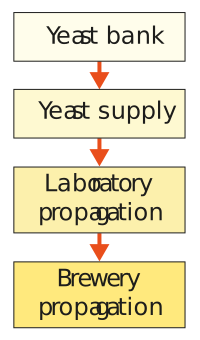
Figure: Elements of yeast propagation
-
The culture naturally has to be sourced from somewhere. In a large brewing company, they might look after their own strains. Alternatively, some brewers might pay someone else to look after the yeast for them, or they may just simply buy new cultures, available to anyone on a demand and supply basis. Whichever option used, the curator of cultures (yeast manager of the yeast bank), has to guarantee to supply the correct and pure strain in a form that is fit-for-use.
-
The yeast supply system is a quality system that underpins propagation. It describes all the methods used that ensure the yeast used in brewing is exactly as it should be. It should be fully traceable so that a ‘lot’ code on a batch of beer should be traceable to details of the history of the yeast batch used to make it.
-
The laboratory propagation system covers retrieving the chosen yeast from storage and growing it in the laboratory up to the point where there is enough to transfer into the brewery propagation plant.
-
The final stage is brewery propagation, where enough yeast is grown to pitch into the first production-scale fermentation.
It is easy to appreciate that this process is only as strong as its weakest link, and therefore, the quality system exists to make sure that there is not one.
The whole of process of yeast handling, which brings together fermentation operations and propagation, sometimes called the brewery yeast cycle, is summarised in the next figure.
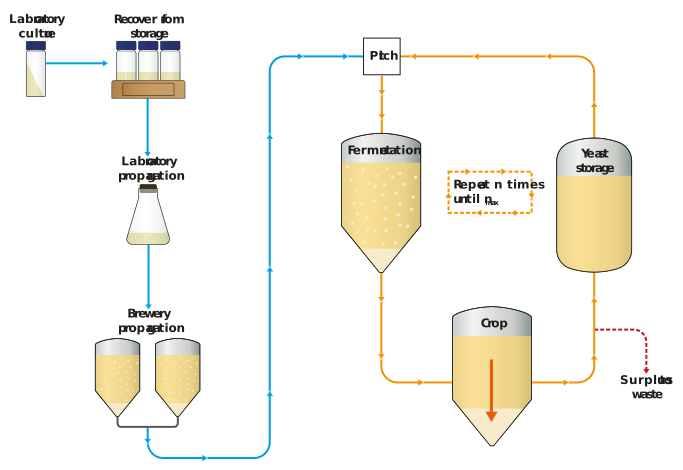
Figure: The brewery yeast cycle