
Lesson 6 - Yeast Propagation
This lesson explores yeast propagation, the supply of pitching yeast and its fitness for purpose. We will explore yeast cultures and the protocols for its storage, along with how to propagate new cultures within the laboratory. This knowledge will enable us to demonstrate an understanding of the design features required for a yeast propagation plant.
Brewery Propagation Plant
We will now consider the design and operation of a brewery propagation plant.
Traditional designs
These are generally made to good hygienic standards and are fitted with a method of attemperation; they typically have little in the way of ensuring efficient aeration or oxygenation.
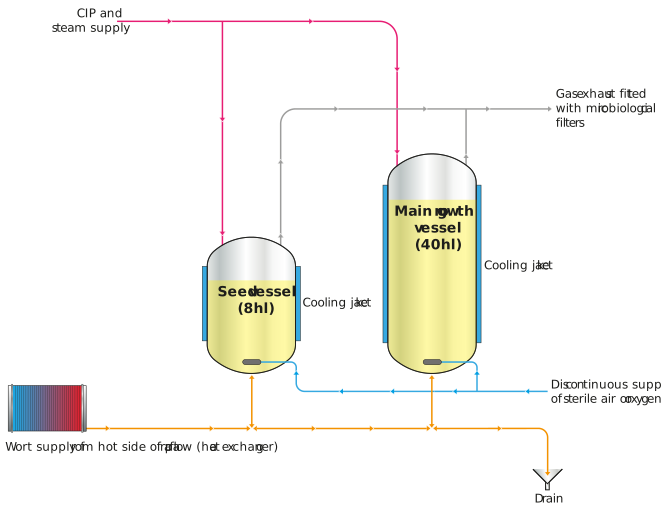
Figure: Two-tank traditional propagation plant consisting of a seed vessel (8 hL) and main propagation vessel (40 hL).
A typical plant used mainly for ale yeasts is shown above. Vessels are cooled via wall jackets, and during the growth phase, air is added using a discontinuous regime.
Other traditional systems use greater numbers of tanks to generate sufficient yeast for pitching. These multi-tank systems can be slow, and the process can be shortened by using a method where part of the contents of one tank is held back and then topped up with fresh wort. A scheme illustrating a regime of this type is shown in the following figure:
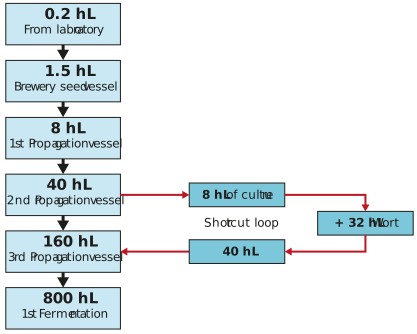
Figure: Scheme showing a traditional propagation regime using a seed vessel and three propagation stages. The short cut loop allows 8 hL of the 2nd stage 40 hL propagation to be withheld and added to 32 hL of fresh wort and so avoids the earlier stages
Consider the potential drawbacks of this shortcutting method of propagation.
Give yourself 5-10 mins to think about this and then click ‘Next’ to continue with this lesson.